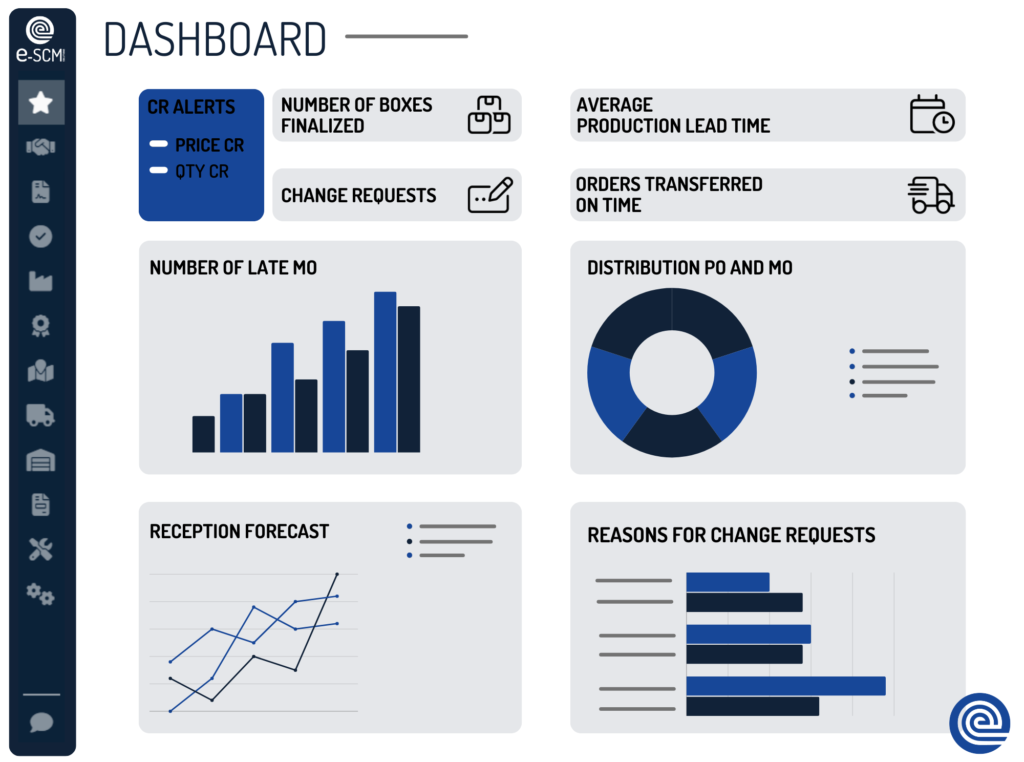
In the fashion industry, managing fashion production has become a strategic issue. Between the proliferation of suppliers, the acceleration of collection cycles, the diversification of sourcing, and the pressure on time to market, brands need real-time visibility into the progress of their production.
Poor coordination between purchasing teams, suppliers, freight forwarders, and logistics providers can lead to delays, additional costs, or stockouts. To address these challenges, the e-SCM platform centralizes information and communication throughout the entire production cycle.
Discover how to digitize production launch, secure your supplies and improve collaboration with all your partners.
Article updated on 03/06/2026.
Production is a critical step in the upstream supply chain of the fashion industry.
Brands today must manage:
The proliferation of collections, the diversification of sourcing areas and the acceleration of marketing cycles make production management more complex than before.
This trend is confirmed by The Interline's 2025 report on sourcing and supply chain in the fashion industry, which highlights the acceleration of investments in digitalization, visibility of flows and collaborative tools to strengthen the operational resilience of brands.
In this context, having real-time visibility on orders and their progress becomes essential.
The e-SCM platform allows purchasing, sourcing and production teams to track each step of the order lifecycle from validation to delivery.
The first step is to validate the commercial terms between the brand and its supplier.
Thanks to the e-SCM platform, stakeholders can collaborate directly on key elements of the order:
All exchanges are logged and accessible in real time.
The platform also allows collaboration with production suppliers by centralizing exchanges, validations, and order adjustments in a shared environment.
Information is shared within a single system.
Teams no longer need to exchange multiple emails to obtain validation or retrieve the history of a decision.
The risks of desynchronization are greatly reduced.
Even after commercial validation, some modifications may still be necessary.
The platform automatically synchronizes updates with ERP systems to ensure data consistency throughout the process.
This flexibility allows for better management of production uncertainties while maintaining control over supplier commitments.
Purchasing teams can define their own monitoring indicators.
For example :
Each indicator provides precise visibility into the progress of production.
Production milestones help to secure critical stages.
Some actions may be automatically blocked until the required validations have been completed.
For example :
This approach significantly reduces the risk of error or non-compliance.
Once manufacturing is complete, suppliers generate a standardized packing list.
Freight forwarders then benefit from advance visibility on:
This anticipation improves logistics planning and reduces the risk of delays.
Thanks to the packaging data recorded in the platform, shipments can be automatically grouped according to their point of origin.
The benefits are numerous:
The logistics teams directly manage the flows from the platform:
The solution thus integrates functionalities similar to a TMS (Transport Management System) within the supply process.
The e-SCM platform relies on APIs to connect the main tools on the market:
Among the systems frequently interfaced:
Reference data and purchase orders are thus automatically synchronized.
APIs allow:
The solution is available:
Beyond operational management, the digitalization of supplies is transforming the relationships between brands and their partners.
Suppliers become fully integrated players in the decision-making process.
By promoting transparency in exchanges and the sharing of reliable data, the platform also helps to improve the maturity of the supplier relationship across the entire supply chain.
The observed benefits include:
Production management is no longer limited to order tracking.
To ensure successful collection launches, brands must be able to:
By centralizing all these processes, a collaborative platform like e-SCM makes it possible to improve visibility, reduce operational risks and strengthen the performance of the upstream supply chain.