A supplier portal for efficient order management
In the textile industry, where production cycles follow one another at the pace of successive collections with strong specificities between the different product families, the coordination of all actors in the Supply Chain is very important.
Mastering Lead Time is a key issue because it determines the achievement of commercial objectives for bringing new collections to market or replenishing distribution channels.
This article is aimed at supply chain managers, procurement officers and managers of textile companies, offering concrete levers to optimize lead time while preserving quality and costs.
In a sector where production cycles are short and demand is constantly evolving, managing upstream supply chain orders is a key performance driver. It directly impacts product availability, on-time delivery, and cost control.
However, this process involves complex coordination between various stakeholders: brands, suppliers, logistics providers, and procurement teams. Without a structured framework and appropriate tools, companies can quickly encounter inefficiencies that slow down their operations.
Delays in confirmations, lack of prompt responses from suppliers, unilateral modification of contract terms.
Use of emails, Excel files and various applications, resulting in a lack of centralization.
Poor transmission of information between departments, data entry errors or changes not taken into account.
Lack of a consolidated history of trades and arbitrations.
Faced with these challenges, structuring and streamlining order management becomes essential to secure flows and guarantee optimized production.
The order management modules of the e-SCM solution are a true optimization lever for companies wishing to improve their organization. Thanks to its advanced features, it enables secure exchanges, centralizes information, and increases productivity while strengthening collaboration with suppliers.
All centralized ordering information
Centralizing communication not only secures lead times but, more importantly, eliminates the use of Excel files and lengthy emails by consolidating all information in a single tool. This contributes to smooth and responsive change management, resulting in significant time savings. Finally, the traceability of decisions and arbitrations is ensured, providing a complete history of interactions.
Secure information under all circumstances
Information is shared instantly on a secure platform (via a robust authentication system and an application that undergoes regular penetration testing), ensuring greater transparency and responsiveness. Contractual exchanges with suppliers are protected, thus limiting the risk of errors or data loss.
Real-time collaboration with suppliers
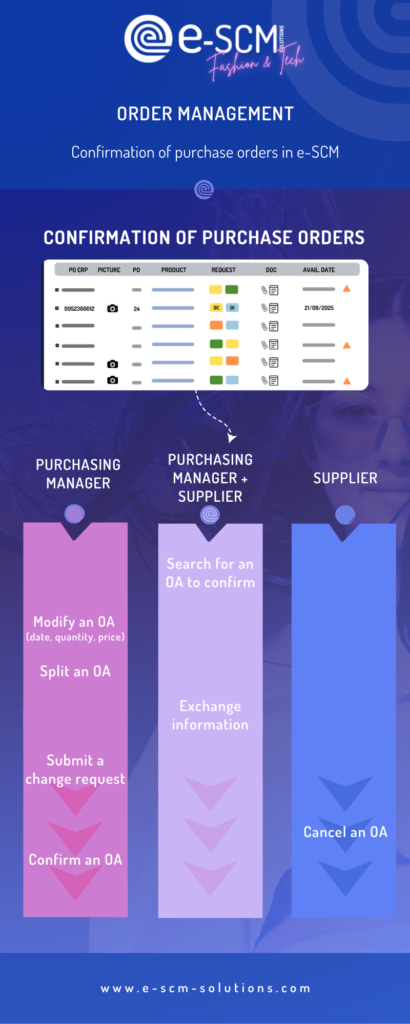
Using e-SCM facilitates adjustments in consultation with suppliers. Available features include:
Process automation
Change requests are automatically integrated into the platform, synchronized with internal systems, and updated in real time. This reduces the risk of human error associated with manual data entry and ensures seamless communication between stakeholders. The use of APIs can be an additional advantage.
Order Confirmation Exception-Based Management is a management method that only deals with anomalies or discrepancies related to order confirmation.
With exceptional piloting :
This operating method saves time because it allows us to focus on the problems; we also note a reduction in errors and delays.
For each of the indicators opposite, a summary email is sent to the relevant stakeholders, according to a frequency to be configured.
The e-SCM dashboard lists all the actions to be taken to manage the identified problems.
The module allows you to enter purchase orders, whether for finished products or raw materials, and assign them to the appropriate suppliers. This functionality offers great flexibility, particularly for:
Orders for raw materials/components and finished products are submitted to suppliers for confirmation. This step allows us to:
Based on expected delivery dates, e-SCM allows for the consolidation of purchase orders and the flexible management of changes. Features include production lead time and scheduling arbitration, pricing and quantity management, and consideration of transport modes, shipping locations, and specific instructions.
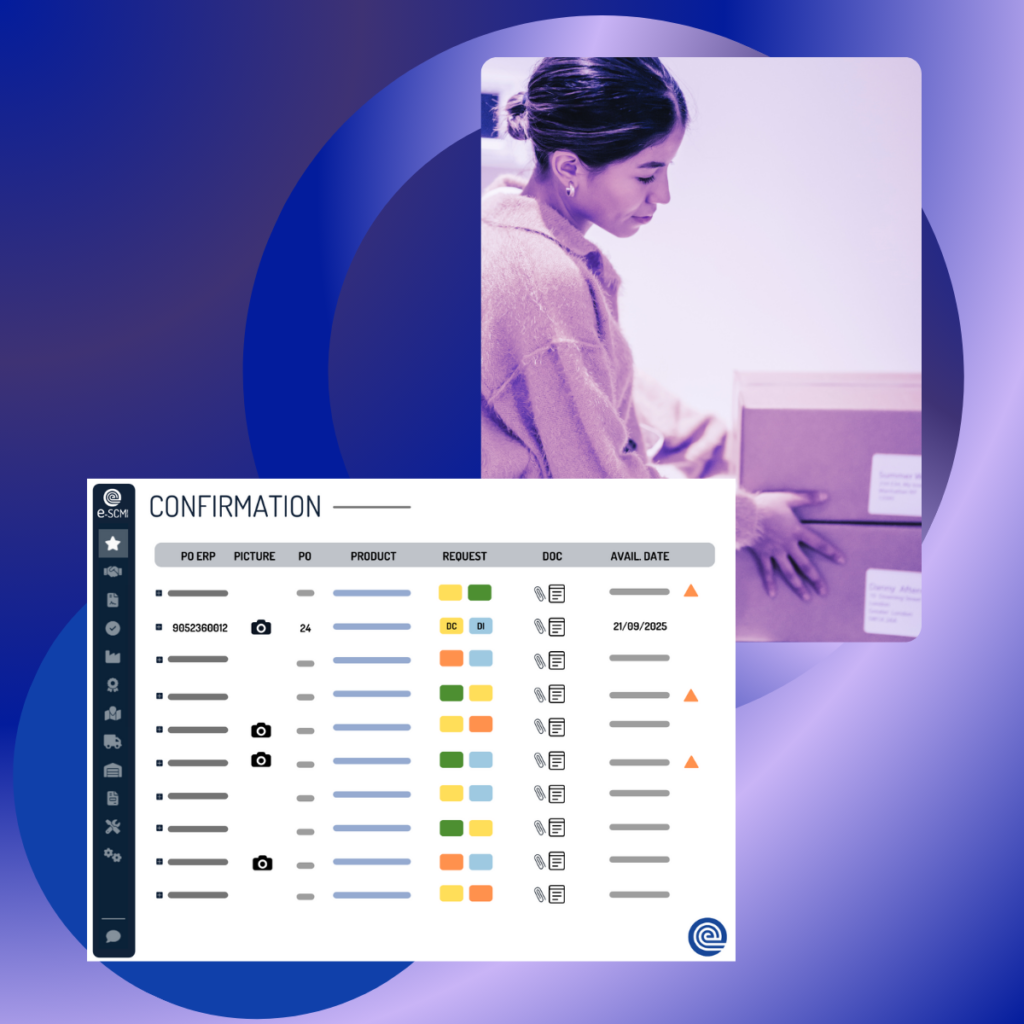
A schedule is provided to ensure rigorous tracking of different types of orders. Users can access order details (quantities, deadlines, attached files) and adjust production schedules in consultation with suppliers. Furthermore, this allows for tracking exchanges and decisions to guarantee optimal handling of requests. Finally, users confirm orders to initiate production tracking.
The modules offer extensive customization of the interfaces and displayed data. In fact, there are advanced filters: each user can apply filters to display relevant information and manage only the suppliers under their responsibility.
The e-SCM collaborative platform also offers screen customization, with the displayed columns being adjustable according to needs to ensure maximum user comfort.
Finally, each brand can decide, in each language, on the naming of all the application labels in order to adapt them to the company's terminology.