Two perspectives: operational and managerial
What role does technology play in better managing your supply chain and improving your ROI?
stakeholders Supply chain can view technology as a pivot to better manage their supply chain.
The answer to this question can be broken down into two perspectives: the operational and managerial.

The major challenge for a supply chain , or any stakeholder in the chain, is to manage operations real to achieve performance and efficiency. Technologieslike such asportals,supplier the e-SCM solution, enable -time management of the entire supply chain stakeholders connected .
○ Plan production with your suppliers
○ Monitor production and minimize risks
○ Mastering quality control of the chain
○ Ship and receive goods
○ Guarantee product transparency and traceability
Centralizing data from various stakeholders and ensuring seamless communication within a single platform guarantees transparency throughout the supply chain. e-SCM offers customizable dashboards with performance indicators for the brand's supply cycle. This decision-making tool secures the process and minimizes production disruptions.
e-SCM enables the automatic collection of data through secure APIs and the creation of a single , shared repository in real time. All of the company's tools can interconnect with e-SCM (PLM, WMS, freight forwarders, etc.) and increase the solution's efficiency.
The role of technology in supply chain management also serves a managerial purpose by improving the responsiveness and efficiency of teams . Our : e-SCM addresses the following challenges solution
○ Refocus on high value-added tasks
○ Connect the entire ecosystem
○ Promote skills development (internal and external)
○ Facilitate collaborative decision-making
Indeed, the e-SCM collaborative platform tasks high-value, rather than on data consultation and consolidation, which can be very time-consuming. The main objective is to replace complex Excel files and simplify the data retrieval process.
This immediate standardization results in considerable time savings, coupled with an efficient workflow for discussing and agreeing on modifications to a purchase order attribute among the various stakeholders involved. This eliminates lost emails and version control issues.
This will have beneficial effects on relationships with teams and various suppliers , who are placed at the heart of the relationship. Aspoints outour product manager, Gilles Bidart, “no longer having to rush to present information will allow us to spend much more time analyzing it.”
The entire ecosystem matures and fosters communication between all stakeholders. This leads to increased productivity and skills development.
As you will have understood, the role of technology is becoming essential, facilitating collaborative decision-making and strongly impacting the return on investment (ROI) of brands.
The positive impact on certain ROIs is a priority and the advantages developed above quickly prove this, from the first collections managed on the platform.
We rely on feedback from our clients such as Rip Curl, Petit Bateau or Aigle, to express the gains perceived by brands that use the e-SCM solution.
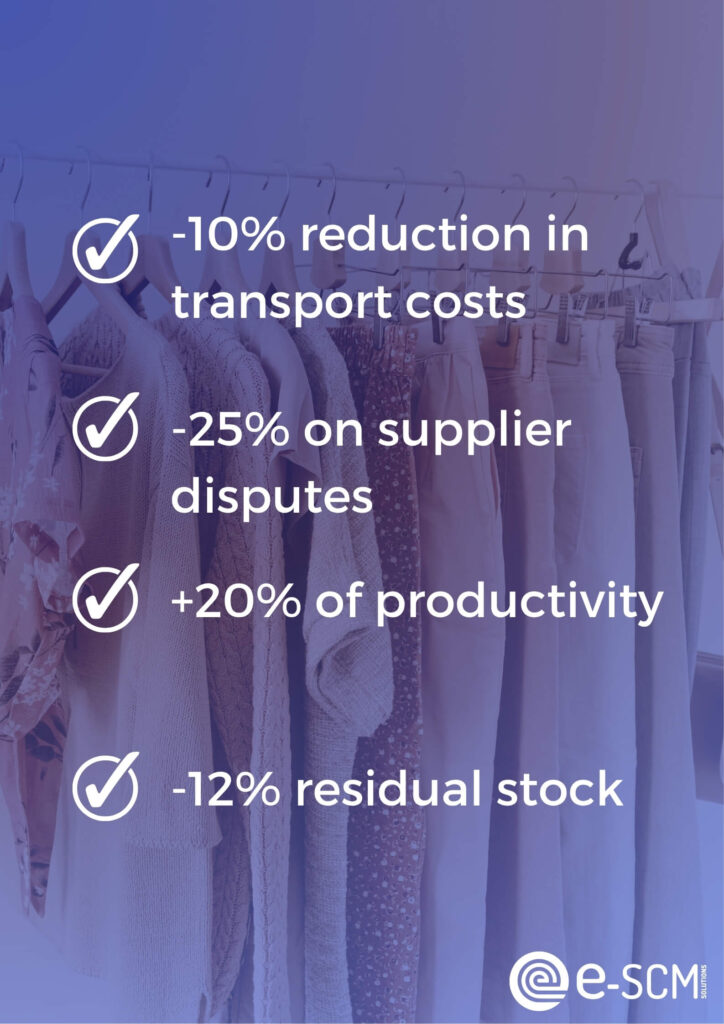
○ Increased productivity: Improved processes for all actors in the value chain and easier decision-making, thanks in particular to integrated e-SCM dashboards, offer a productivity gain of 20%.
○ More performance: A secure supply chain that copes with manufacturing uncertainties, production monitoring that limits stockouts and ensures availability in stores results in a 25% reduction in disputes with suppliers.
○ Reduction in scrap rate: Thanks to the dedicated Quality process monitoring module and better control of tests and controls, we were able to observe a 12% reduction in residual stock.
○Optimized transport: Tracking theroutegives visibility the logistics provider on the transport capacities to anticipate and thus allows for the rationalizationofcosts by proposing groupingsshipment, resulting in a 10% reduction in transport costs.
Overall, we are convinced that the digital transformation of all links in the supply chain is essential to meet the new challenges of the textile industry and respond to the demand of the end consumer.
If you would like to learn more about our solution, please feel free to schedule an online appointment with our business developer Antton or book a demo!
KPIs should enable the detection of deviations and the prioritization of actions, not just the recording of past performance. On-time delivery (OTIF), adherence to production milestones, lead times, supplier performance, non-conformities, and delivery delays are among the key indicators. With the e-SCM Insights module, this data is centralized in dashboards that allow for real-time performance monitoring, deviation analysis, and the identification of orders or suppliers requiring intervention.
The ROI of a digitalization project is measured by both financial gains and operational improvements. It is relevant to compare, before and after deployment, the time spent on administrative tasks, team productivity, delays, on-time delivery (OTIF), and costs related to transportation and supply chain disruptions. In the case of e-SCM, these indicators allow for a concrete measurement of the benefits of data centralization, automated processes, and improved upstream supply chain management.
Reliable supply chain decision-making requires reliable, complete, and up-to-date data. When information is scattered across ERP, PLM, Excel files, emails, and supplier communications, teams spend time consolidating it before they can even analyze the situation. e-SCM centralizes data related to orders, suppliers, production, quality, traceability, and transportation to provide a consistent view of operations. This allows teams to identify discrepancies more quickly and act on priorities.
Improving performance often involves reducing non-value-added tasks rather than adding resources. With e-SCM, automating supplier exchanges, centralizing information, and eliminating data re-entry allows teams to dedicate more time to management and planning. Better visibility into orders and risks also helps limit emergency actions, delays, and certain logistical overruns, while improving team productivity.
The main obstacles are often organizational: scattered data, supplier communication via email, data re-entry, lack of visibility into order progress, or late risk detection. These difficulties make management more reactive than proactive. A platform like e-SCM brings internal teams and suppliers together in a single environment around operational data. Alerts, indicators, and up-to-date information then facilitate the identification of discrepancies and the prioritization of actions.
Gains are only sustainable if performance is measured regularly and if teams have the necessary resources to address any gaps. The e-SCM Insights module allows you to track KPI trends, analyze performance gaps, and identify trends related to suppliers or operations. This approach transforms reporting into a tool for continuous improvement: data is used not only to measure results but also to guide future actions and sustain progress over time.