Supplier Relationship Management
Supplier relationship management ( SRM) has become a strategic lever for companies wishing to optimize their supply chain.
In demanding sectors such as fashion and luxury, companies must not only secure their supplies, but also strengthen collaboration with their industrial partners.
Implementing a Supply Chain Management (SRM) helps structure interactions with suppliers, improve overall performance, and anticipate risks. This approach is also becoming essential to address the challenges of sustainability, regulatory compliance, and supply chain digitalization.
But how do you know if your organization is ready? And above all, what is your SRM maturity level ?
Have you ever wondered how companies structure their interactions with their suppliers?
Supplier Relationship Management (SRM) represents a major evolution in this approach. It aims to transform supplier relationships into true strategic partnerships .
In the fashion and luxury, this approach is becoming essential for:
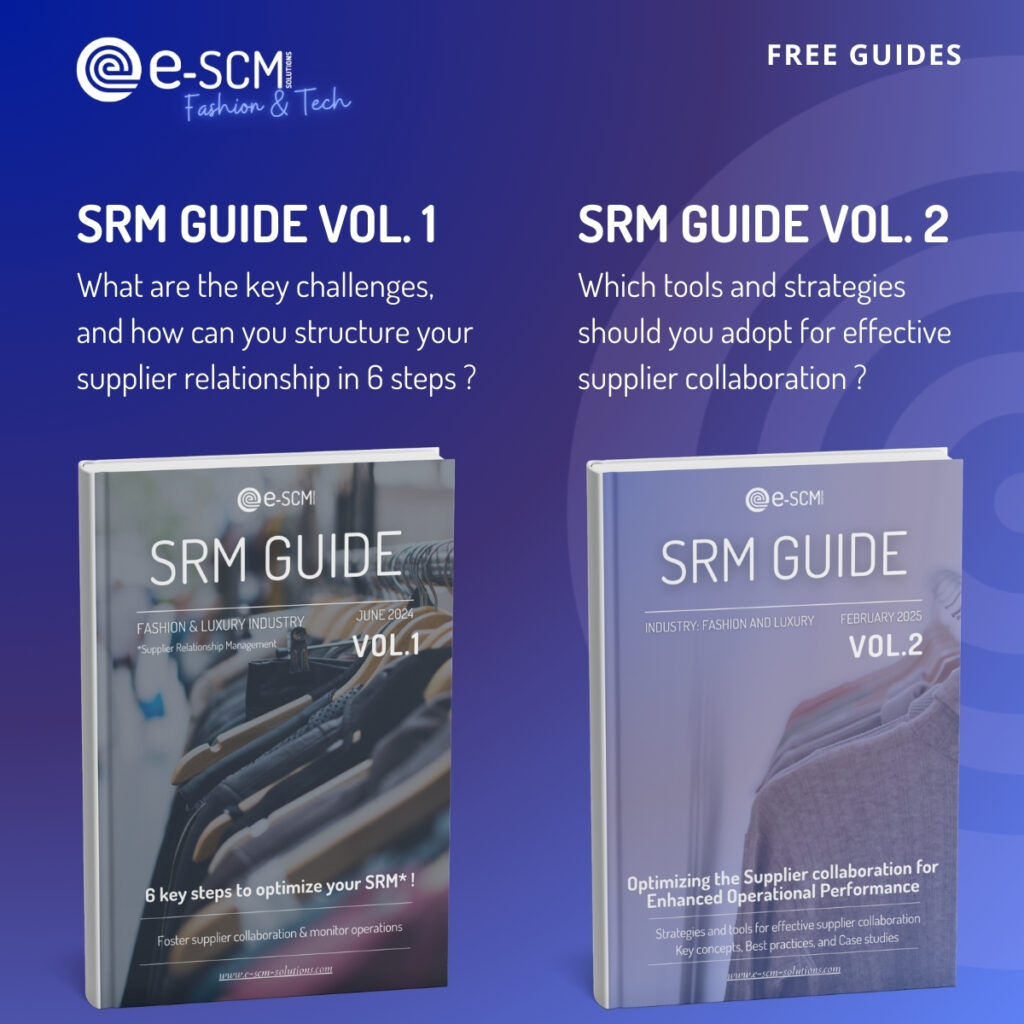
To support this transformation, e-SCM has developed a practical guide to help companies implement a structured and efficient SRM approach.
Supplier Relationship Management (SRM) is a strategic approach that aims to optimize the relationships between a company and its suppliers.
It encompasses a set of practices, processes, and technologies that enable:
Unlike traditional supplier management, which is often focused on price negotiation, SRM adopts a long-term vision.
Suppliers are considered key partners in the supply chain, capable of contributing directly to the overall performance of the company.
The SRM encourages close collaboration between the company and its suppliers.
Rather than simply imposing contractual requirements, the goal is to build an environment where both parties work together to achieve common objectives.
Supplier performance management is a central element of SRM.
It consists of regularly measuring:
These indicators help to identify areas for improvement and strengthen overall performance.
SRM aims to transform suppliers into strategic partners.
This relationship is based on:
The goal is to create sustainable value for both parties.
Managing supplier relationships also involves identifying and controlling risks, including:
An effective SRM strategy makes it possible to anticipate these risks and strengthen the resilience of the supply chain.
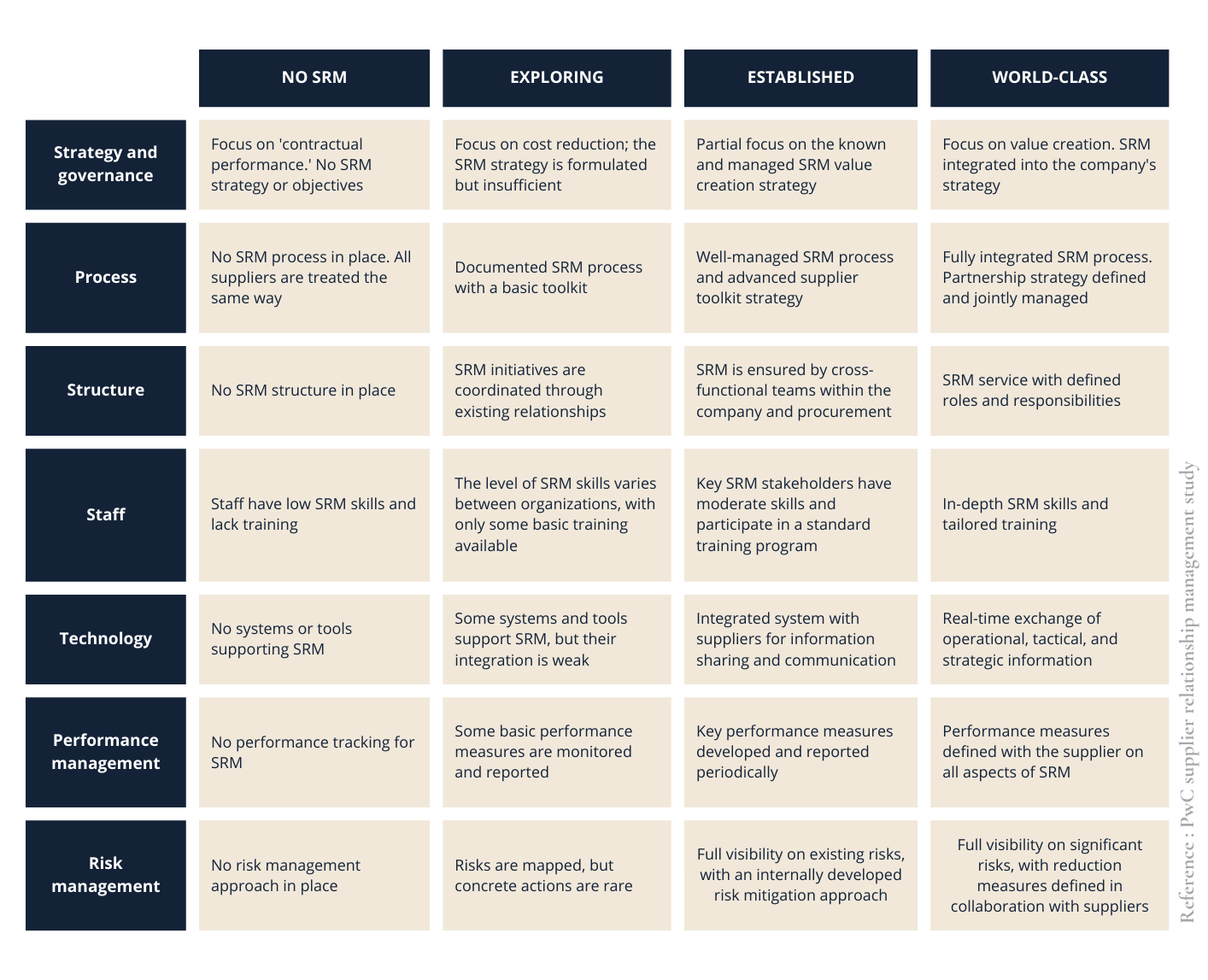
Assessing the maturity level of your supplier relationship management is an essential step in identifying areas for improvement and building an effective strategy.
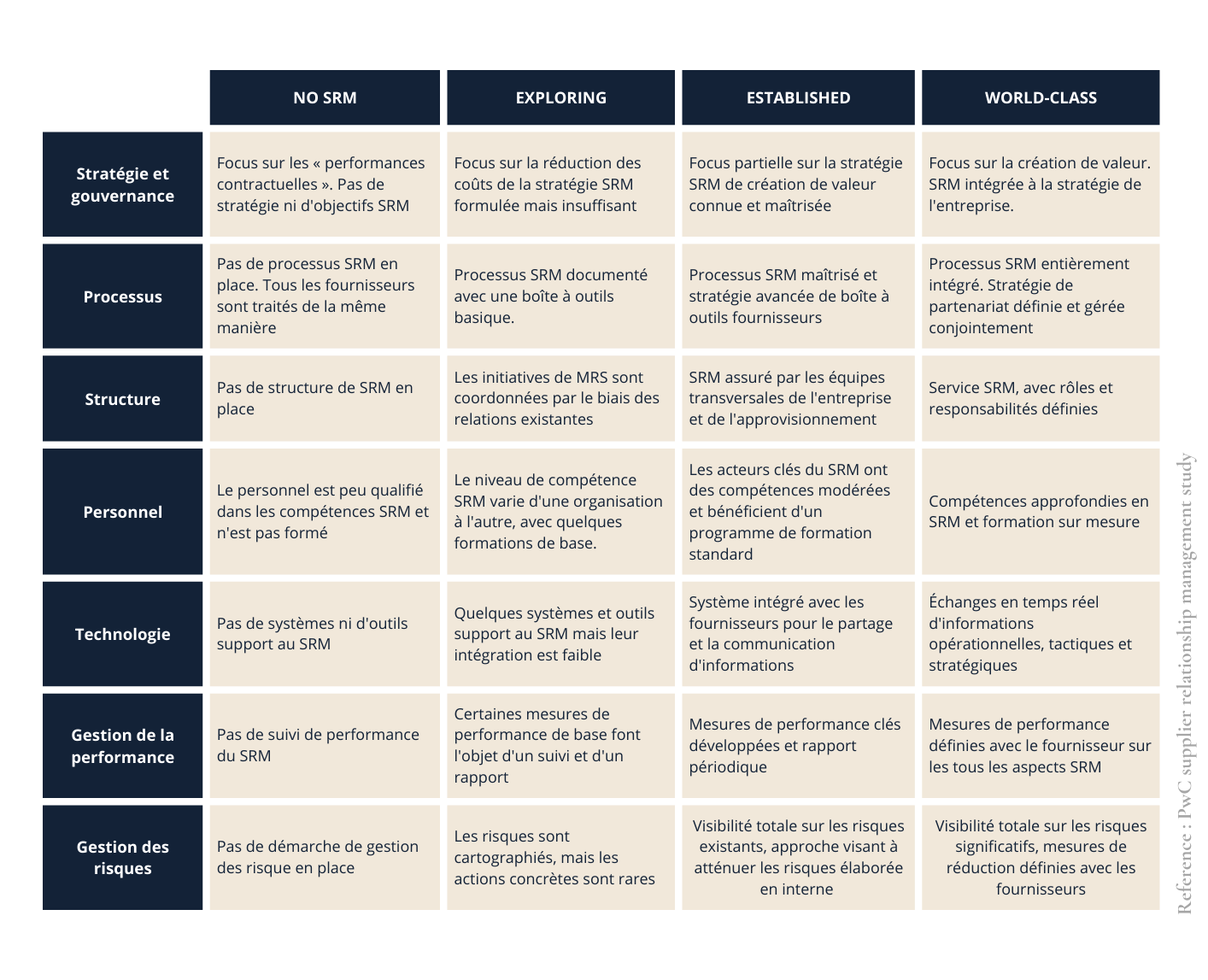
PwC proposes an assessment model based on four levels of SRM maturity :
Each level corresponds to a degree of integration of SRM into the organization.
Description :
At this stage, there is no formalized strategy for managing supplier relationships.
The interactions are primarily reactive and unstructured.
Features :
Description :
Companies are beginning to recognize the importance of SRM and are launching their first initiatives.
However, these actions remain limited and poorly integrated across the organization.
Features :
Description :
Organizations have structured and integrated SRM processes.
Supplier relationships are managed proactively and supported by technological tools.
Features :
Description :
World-class organizations have integrated SRM into their overall strategy.
Supplier relationships are becoming a real competitive advantage.
Features :
Supplier Relationship Management represents a major evolution in the management of supplier relationships.
This approach allows:
To assist you, e-SCM offers a practical SRM guide detailing:
Today, SRM is a strategic lever for building a more sustainable, resilient and efficient supply chain.
Are you ready to transform your supply chain?