We observe that the textile industry is evolving and still impacted by the health crisis of recent years. In this context , fashion brands are striving to find their way back to effectiveness and efficiency , with interactions between stakeholders, suppliers, manufacturers , carriers , and data being more crucial than ever
These interactions have been impacted, and to this day they are experiencing a certain obsolescence, particularly on tools such as Excel spreadsheets , emails and other channels which can maximize risks and thus tarnish the productivity and efficiency of the brand.
It then becomes essential to turn to the digitalization of supplies, which makes it possible to facilitate the workflow and improve productivity while developing the sustainability of practices.
And what happens to the data in all of this?
Find Caroline and Sicco's answer in the replay of the webinar which deals with supplier relations and data management!

Your data is precious and represents your greatest asset. It must be secure, protected, and above all, controlled. Traceability in the supply chain thus corresponds to monitoring data exchanges and interactions between the various stakeholders in the chain. This concept is becoming paramount and a priority for brands today. Indeed, as we mentioned in the introduction, the global pandemic and new legislation coming into effect are forcing brands to prioritize their strategy in this area.
Therefore, to ensure data traceability in particular, it is crucial to digitize supply chain processes. This digitization places the brand at the heart of its market through increased productivity and efficiency.
Having a 360° view e of the supply chain promises visibility - SCMplatform and risk .management The enables control over data and tracking within the brand . The implementation of the solution with the CWF group , for example, demonstrated "end-to-end traceability of the chain "because " all actors in the upstream chain are involved: internal departments , suppliers and factories, testing laboratories, freight forwarders. "
Beyond data traceability, since everything is recorded historically, the e-SCM platform is an essential tool for strengthening . supplier relationshipsThis is particularly true for the Lithuanian supplier PHB Group, which testifies to the increased agility gained by using the e-SCM platform, stating that the dynamics of communication and the quality of work are enhanced". In short, these testimonials highlight the benefits provided by the e-SCM solution and, more generally, the digitalization of processes andmanagement.

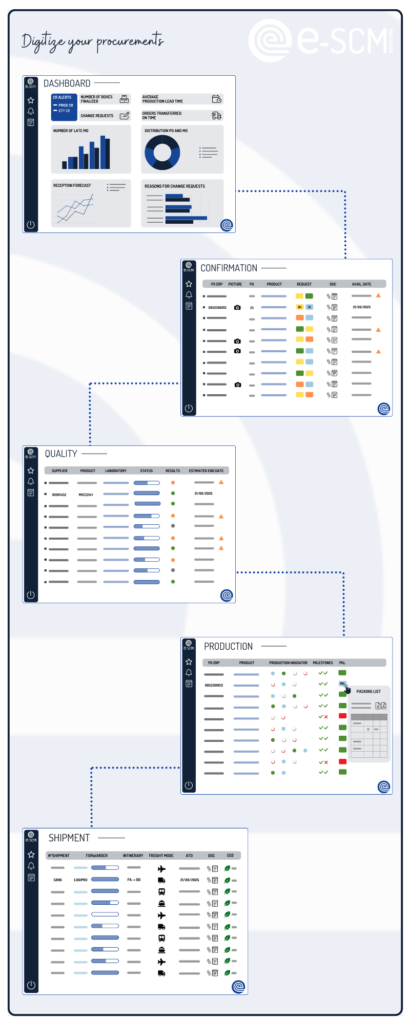
In the various e-SCM modules, specific tools allow each link in the Supply Chain to reliably record and share traceability information between stakeholders.
•Supervise: Manage your Supply Chain with a 360° view of the procurement process
•Order: Plan your production in consultation with your suppliers
•Production: Control your production and minimize risks
•Control : Optimize quality monitoring throughout the supply chain
•Shipping & Receiving: Optimize transport methods and coordinate goods receipts
•Trace : Control the traceability of your products and inform consumers with QR codes.
Therefore, to ensure data traceability in particular, it is crucial to digitize supply chain processes. This digitization places the brand at the heart of its market through increased productivity and efficiency.