In the fashion and luxury sectors, the supply chain has become a top management issue. Successive crises have profoundly changed the priorities of supply chain managers: it is no longer just about optimizing costs or lead times, but about ensuring product availability in an environment that has become structurally unstable.
Geopolitical tensions, supplier dependence, logistical inflation, demand volatility, and accelerated collection cycles: brands today have to manage much more complex supply chains than they did five years ago.
In this context, the service level has become a strategic indicator. It measures a company's ability to deliver the right products, at the right time, and in the right quantities. The following factors are directly at play behind this indicator:
A degraded service level immediately results in:
The real question for supply chain management is therefore no longer just “how to optimize costs?”, but above all: how to sustainably secure the customer promise despite the instability of flows?
Today, only 10% of companies have clear visibility across multiple levels of their supply chain, according to a France Supply Chain & Sopra Steria Next study published in 2025.
This lack of visibility severely limits companies' ability to anticipate disruptions, manage supplier risks, and sustainably improve their service levels.
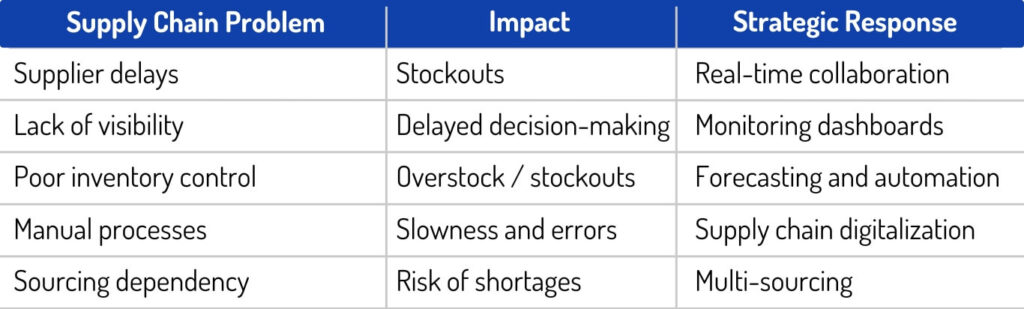
Many brands have long favored supplier concentration strategies to gain a competitive edge. Today, this approach is showing its limitations.
Dependence on a single geographical area or a limited number of partners severely undermines the continuity of supplies.
Multi-sourcing therefore becomes an essential lever for:
How many companies still discover too late that a critical supplier represents a major point of weakness in their supply chain?
The most advanced supply chain management teams are now working on hybrid models combining proximity, flexibility and capacity security.
Making your supply chain more agile isn't just about speeding up flows. It relies primarily on the ability to quickly adjust production to actual demand.
More precise control allows for:
The objective is no longer simply to optimize costs, but to preserve the balance between availability, flexibility and risk management.
The real challenge today is being able to absorb variations in demand without degrading the level of service.
In fashion and luxury, a quality problem immediately generates significant operational impacts: delays, rework, logistical blockages or product unavailability.
Supplier quality management therefore becomes a subject directly linked to the service rate.
The most successful companies today are strengthening:
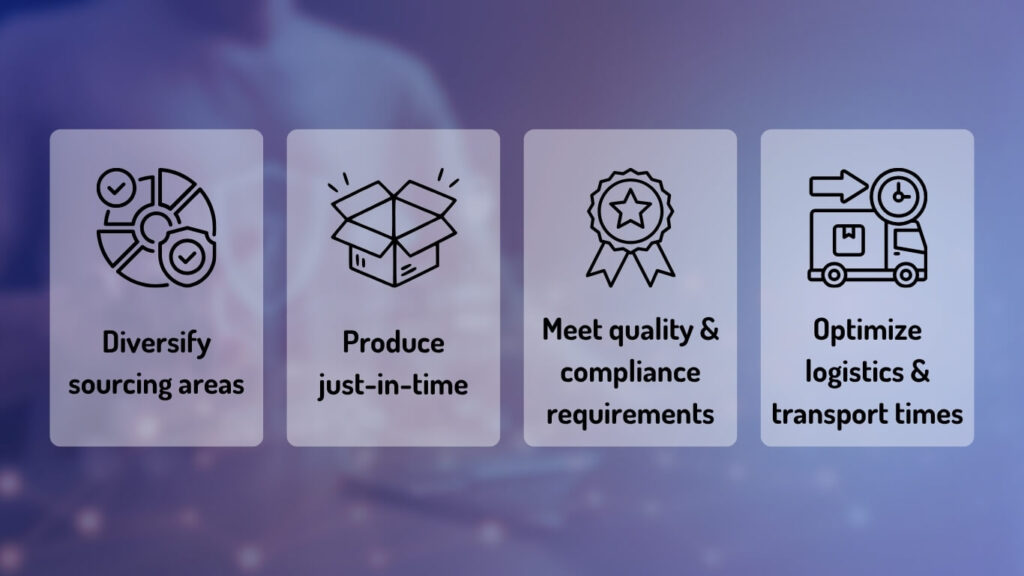
One of the main challenges for supply chain management remains the lack of visibility on upstream flows.
However, without real-time visibility, it becomes extremely difficult to anticipate delays, identify supplier risks, or make the right decisions quickly.
The most resilient organizations are now investing in:
Visibility is no longer simply an operational convenience: it is becoming a direct factor in performance and responsiveness.
The goal is simple: detect earlier in order to react faster.
In the most mature organizations, suppliers are no longer considered mere executors but strategic operational partners.
Better collaboration allows for:
The most efficient supply chains are not necessarily those with the most resources, but those that collaborate most effectively with their supplier ecosystem.
Inventory remains one of the main buffers against crises. But if poorly managed, it quickly becomes a source of costs or stockouts.
Supply chain departments today must constantly make choices between:
This requires:
The right stock level is no longer a fixed objective: it is a dynamic balance that must constantly evolve according to risks and demand.
Digitalization is no longer just an IT project. It is becoming a strategic lever for resilience and operational performance, particularly through digitalization to secure the supply chain.
Supply chain platforms today make it possible to:
Supply chain departments that continue to manage their flows with scattered Excel files will find it increasingly difficult to absorb future disruptions.
According to KPMG, the most resilient companies are those that rely on real-time data and automation to improve their supply chain agility.
e-SCM Solutions supports fashion and luxury brands in managing their upstream supply chain through:
The platform allows supply chain teams to:
The goal is no longer just to increase productivity, but to empower teams to make faster, more reliable, and more proactive decisions.
An agile supply chain is no longer a competitive advantage. It is becoming a condition for operational continuity.
France Supply Chain & Sopra Steria Next
Supply Chain Resilience Overview 2025
KPMG
The Future of Supply Chain