Manage your warehouse transport and receiving with e-SCM: anticipation & optimization

Introduction

Upstream transport and warehouse receiving management are critical steps in the supply chain. Too often managed in silos, these steps generate inefficiencies, additional costs, and risks of delays.

With the Transport (TMS) module of e-SCM, you can track your shipments in real time, anticipate receipts and coordinate all stakeholders: suppliers, freight forwarders and logistics teams.

The result: an optimized supply chain, reduced costs, better-prepared teams and total transport traceability.

REAL-TIME TRACKING OF TRANSPORT AND RECEIPT

A more reliable forecasting schedule

Upstream transport is a critical link in the supply chain, often managed in silos.


module e-SCM Transport enables:

  • tracking shipments
  • the organization and coordination of expeditions
  • the complete transport route from the supplier to the warehouse


The logistics department benefits from a real-time view of upcoming deliveries, which allows:

  • to adjust team planning
  • to anticipate the volumes to be stored
  • to align customer order preparation with product availability

OPTIMIZE YOUR TRANSPORTATION AND COSTS 

Manage carrier tenders 

The e-SCM platform offers a marketplace for carriers, allowing calls for tenders to be launched directly from the system.

Benefits :

  • selecting the best partner based on cost, time or carbon impact
  • automation of the grouping of finalized productions
  • limitation of partial transport
  • optimizing container filling

Reduction of logistics costs

Thanks to these features, you reduce costs, improve chain performance and limit the environmental impact of transport.

TRACEABILITY, TRANSPORT AND LOGISTICS COLLABORATION 

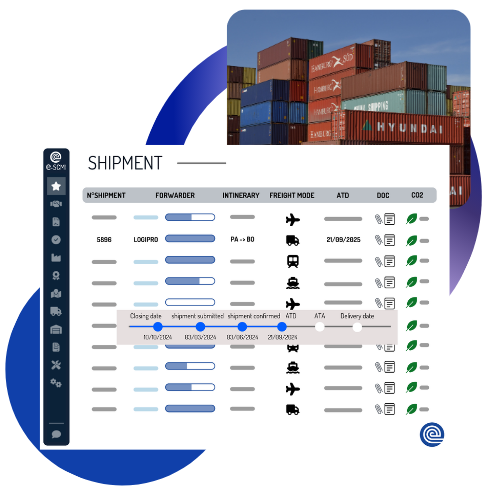
Complete tracking of the goods' journey 

From the production site to the warehouse, e-SCM tracks all the key steps:  

  • Factory release date 
  • Handling by the freight forwarder (ETD / ATD)  
  • Real-time transport tracking (ETA/ATA)  
  • Customs clearance, delivery, receiving, quality control  


Status updates are automatically provided by the freight forwarder via an API connection or a dedicated portal, ensuring reliable and instant information.  

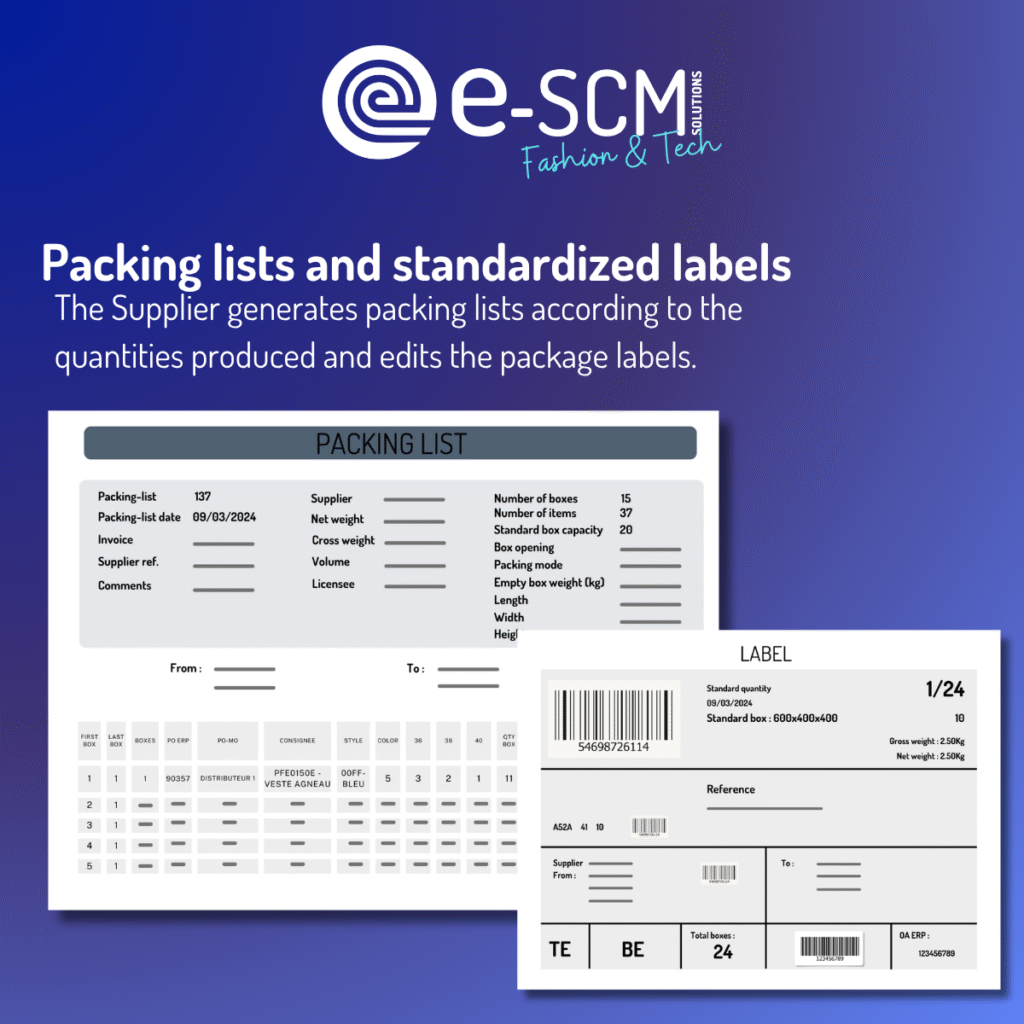
All necessary documents (packing list, labels, customs forms, delivery notes) are collected, standardized and accessible from the platform, avoiding errors and facilitating customs controls.  


The e-SCM collaborative platform also enables quality control at each stage. These controls can be triggered in the workshop (upon shipment), but also on the logistics platform and finally upon receipt at the warehouse.  

Discrepancies are detected earlier, which reduces disputes and improves customer satisfaction.

MANAGE YOUR WAREHOUSE RECEIVES 

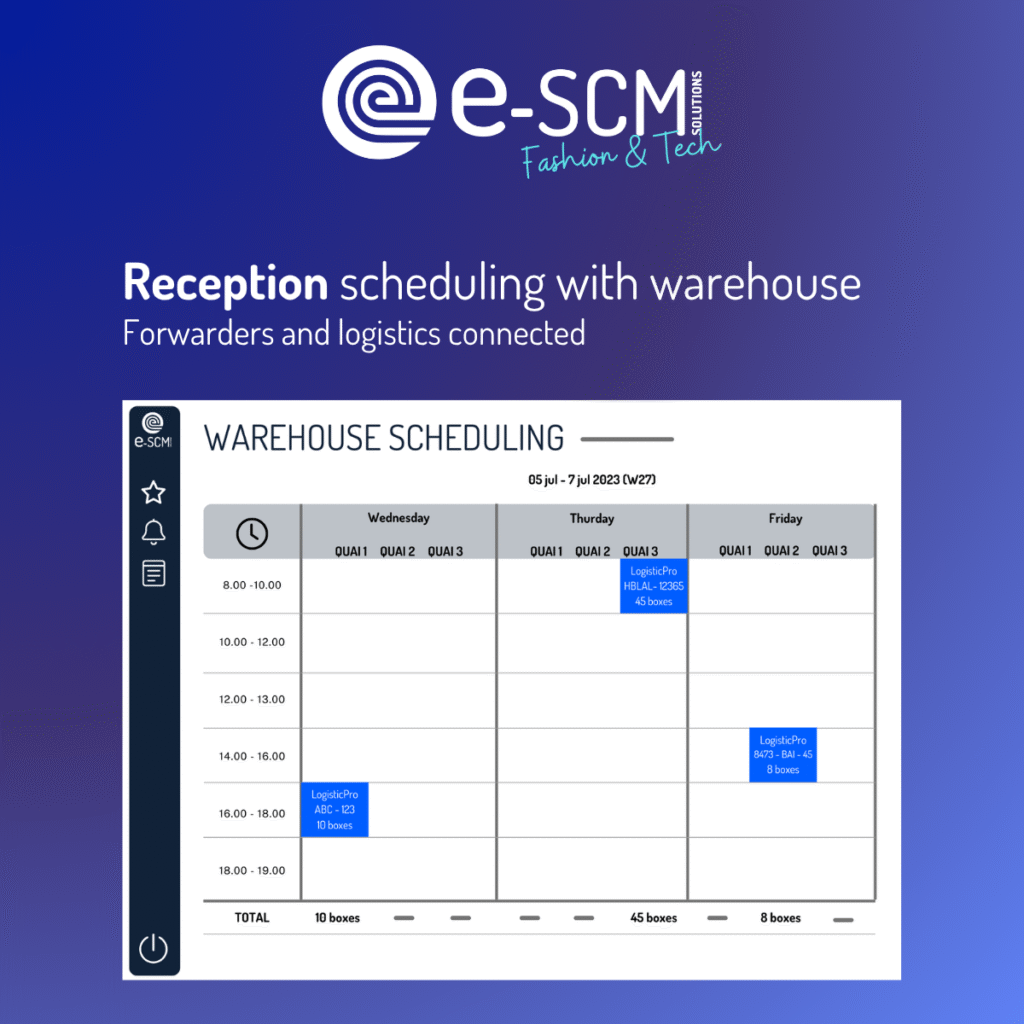
Schedule deliveries and optimize your resources 

With e-SCM, you can smooth out incoming shipments to avoid unexpected load spikes.

The Transport module allows you to:

  • schedule delivery appointments according to storage capacity
  • allow the freight forwarder to schedule appointments via an integrated calendar
  • assign a loading dock

Benefits:

  • improved team productivity
  • reduction in staffing needs
  • smoother and better-prepared receptions

FACILITATING WAREHOUSE INSPECTIONS

Documentation and upstream control

  • Upstream packing plan simplifying reading and checks
  • Standardization of supplier documents
  • Quality control before shipment to limit non-conformities upon receipt

Full traceability

  • Each step is recorded from thepurchase order (PO)
  • Facilitates the identification of the causes of disputes
  • Reduces the workload of the control teams
transport module packing list e-scm

INTEGRATED CARBON MODULE  

Measure your emissions from the upstream transport phase

The e-SCM Carbon module calculates the emissions generated by each shipment and for each of the tracked segments:  

  • The mode of transport  
  • The distance traveled  
  • The volume and weight transported  

For each flow, the data is directly returned in the Transport module, thanks to the integrated calculator ofEcoTransIT World, and it is possible to have a consolidated view of its carbon data according to different criteria.  

With automated reporting, you can compare your service providers based on their environmental performance, and adapt your logistics choices to limit your carbon footprint.  

The Carbon module also provides you with the data needed to meet your regulatory obligations (CSRD, AGEC law) or to feed into your extra-financial reports.  

WHY ADOPT THE E-SCM TRANSPORT MODULE? 

Your key benefits 

  • Reducing transport costs through competition  
  • Streamlining shipments through optimized consolidation  
  • Mastering the data to compile the customs file 
  • Visibility into warehouse deliveries thanks to precise scheduling  
  • Increased productivity of logistics teams  
  • Fewer errors, more traceability throughout the entire transport chain  
  • Better anticipation, therefore better customer satisfaction  
  • Integrated environmental management  

The transport module, an accelerator of performance and responsibility .


Thanks to the Transport module of e-SCM Solutions, enhanced with the Carbon module, you can manage your logistics flows with precision, transparency, efficiency… and responsibility. A more efficient and sustainable supply chain is now within reach.  

Do you want to take your transport digitalization and decarbonization further? Contact our teams for a personalized demo!  

FAQ - E-SCM TRANSPORT AND RECEIPT MODULE

1. What is the Transport module in e-SCM?

The e-SCM Transport module is a functional component of the e-SCM platform that enables the management, tracking, and coordination of all stages of goods transport, from shipment to the supplier to receipt at the warehouse. It centralizes data, automates logistics processes, and facilitates collaboration between the various stakeholders. 

2. What are the advantages of the e-SCM Transport module for logistics? 

e-SCM allows logistics professionals to: Visualize upcoming receipts in real time, Plan deliveries according to storage capacity, Distribute flows to avoid activity peaks, Improve the productivity of warehouse teams through better anticipation. 

3. How does e-SCM help to reduce transportation costs? 

Thanks to an integrated marketplace, e-SCM allows companies to issue requests for proposals to carriers. The system then selects the best providers based on criteria such as cost, delivery time, or carbon footprint. Purchase orders can also be consolidated to minimize partial shipments. 

4. Can the shipment of goods be tracked in real time with e-SCM? 

Yes. e-SCM ensures complete transport traceability via key statuses (ETD, ATD, ETA, ATA) and an automated connection with freight forwarders. Each step is time-stamped, and users can track shipment progress on a dedicated interface. 

5. How does the reception management work in the Transport module? 

The Transport module allows for the scheduling of deliveries using an integrated calendar. The freight forwarder can book appointments online, and the logistics department can assign a loading dock. This streamlined organization improves inventory management and reduces ad-hoc charges. This automation results in significant time savings and ensures consistency between production, logistics, and receiving.

6. What documents are centralized in e-SCM for transport? 

e-SCM brings together all the documents necessary for shipping and receiving: Standardized packing lists - Readable parcel labels - Customs forms - Delivery notes. This ensures documentary compliance and simplifies controls. 

7. Does e-SCM allow us to measure the carbon footprint of transport? 

Yes. The Carbon module integrated into e-SCM calculates CO₂ emissions based on the mode of transport, distance, weight, and volume shipped. This data is consolidated and accessible in real time within the Transport module. 

8. Which freight forwarders are already connected to e-SCM? 

e-SCM offers API connectors with several major freight forwarders such as DHL Express, Dachser, Scan Global… and can interface with other logistics partners according to customer needs.