Today, the textile and clothing sector faces several challenges, including the need to reduce its environmental footprint. Various brands and companies in the textile industry must implement new approaches and mechanisms to ensure greater traceability of the materials and processes used throughout the entire lifecycle of a textile product.
This requires specific organization and resources, the costs of which remain prohibitive compared to the economic balance of the textile and fashion industry. Therefore, through our R&D , e-SCM aims to study long-term developments to our supplier portal, whose primary purpose is supply chain optimization , in order to make it interoperable with other distributed systems to meet traceability challenges and needs .

 What are the key takeaways from your report on transparency and traceability?
Brands can't just declare their commitments. They need to provide proof. Unfortunately, there's no magic bullet for displaying the story of a garment or shoe on its label. Only the collection of dataacross the entire supply chainoffers the possibility of providing reliable information to consumers in the form of a Digital Product Passport. There is no transparency without traceability. And this requires industrializing data collection with technological tools.
How can brands comply with the AGEC law? Several solutions exist, tested and approved by brands worldwide to meet their diverse needs. For large companies, combining supply chain management software , which tracks data from raw material sourcing to manufacturing, transport, and delivery, with QR code reporting on the label, is one of the most effective and accessible methods in terms of price and implementation time.
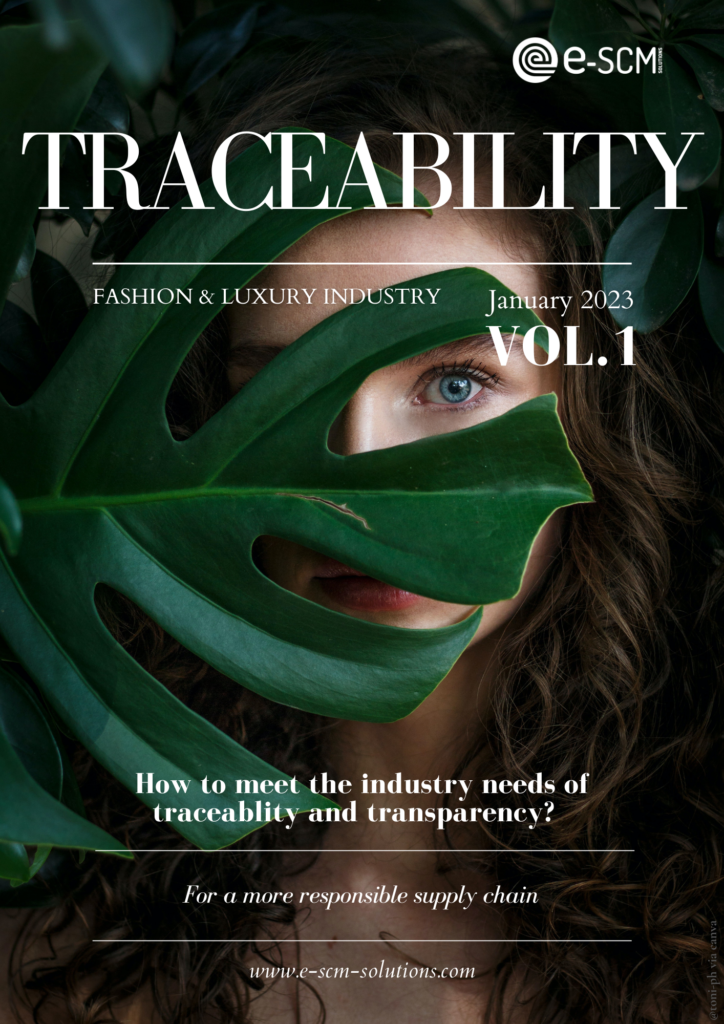
Following our work, we have published a White Paper on Traceability in the Fashion and Luxury Sector | Traceability & Transparency of the Supply Chain for More Responsible Fashion. You can download in your preferred language.
What are the next steps in your work at Belharra with the BALI Chair?
Our work has helped advance the industry towards greater traceability and transparency in the upstream supply chain. It has been recognized in France and internationally, which acknowledges our contribution, particularly regarding the democratization and widespread adoption of the Digital Product Passport.
This passport informs consumers, empowering them to make informed choices. It also serves as a gateway to giving products a second life. We have identified tools on the market that automatically generate listings on resale platforms, including all the necessary information such as a description, details of the materials used, and the country of origin. Furthermore, the
Digital Product Passport will be essential to the recycling sector , as it tracks the exact composition and assesses recyclability.
We are entering the final year of our doctoral research on this central topic: data collection in the service of circularity. And we will thus be able to close the loop.
Pantxika Ospital's thesis is directed by Jérémy Legardeur, Professor at ESTIA and co-supervised by Dimitri Masson, Professor at ESTIA and Cédrick Béler, Professor at ENIT.
Source: Extract from the 2022 activity report of the BALI Chair | Sustainable fashion, towards new standards on an industrial scale (in French).