The year 2023 was a pivotal year for the Bali Chair's traceability working group, marked by the completion of the Chair's first thesis, that of Pantxika Ospital, a traceability specialist consultant.
Through collaborative work within the Chair's ecosystem of companies and our e-SCM clients, we experimented with different types of traceability: "Downstream Traceability," which links data to the raw material from its origin throughout its transformation process, even up to the finished product; and "Upstream Traceability," where, conversely, data is collected from the manufacturing process of the finished products, tracing it back to the origin of the raw material
“By mastering data, the company can more precisely manage its operations and make its processes fully auditable. This is what we mean by Traceability & Transparency,” concludes Patrick Bourg.
At the end of 2023, Pantxika Ospital defended her thesis – Promoting circularity and traceability in the field of fashion and textiles: Proposal of the Digital Product Passport (PNP) to achieve product transparency, thus becoming the first doctor of the BALI Chair.
Initially, Pantxika focused on transparency in the textile sector. By studying the typology of the textile supply chain, it sought to demonstrate its complexity and also noted the lack of traceability in this sector, compared to others that are more advanced, particularly those with the systematic use of tools such as PLM, ERP, and SCM. This observation highlights the need to better understand traceability in the textile sector and to move towards more granular traceability at the product level in order to achieve greater transparency.
To this end, a three-year field survey was conducted with online stores and websites to measure the dynamics between 2021 and 2023. A total of 54 brands were surveyed. During this period, brand communication was driven by the implementation of the AGEC law (Anti-Waste for a Circular Economy) and the environmental labeling projects of the Climate and Resilience law.
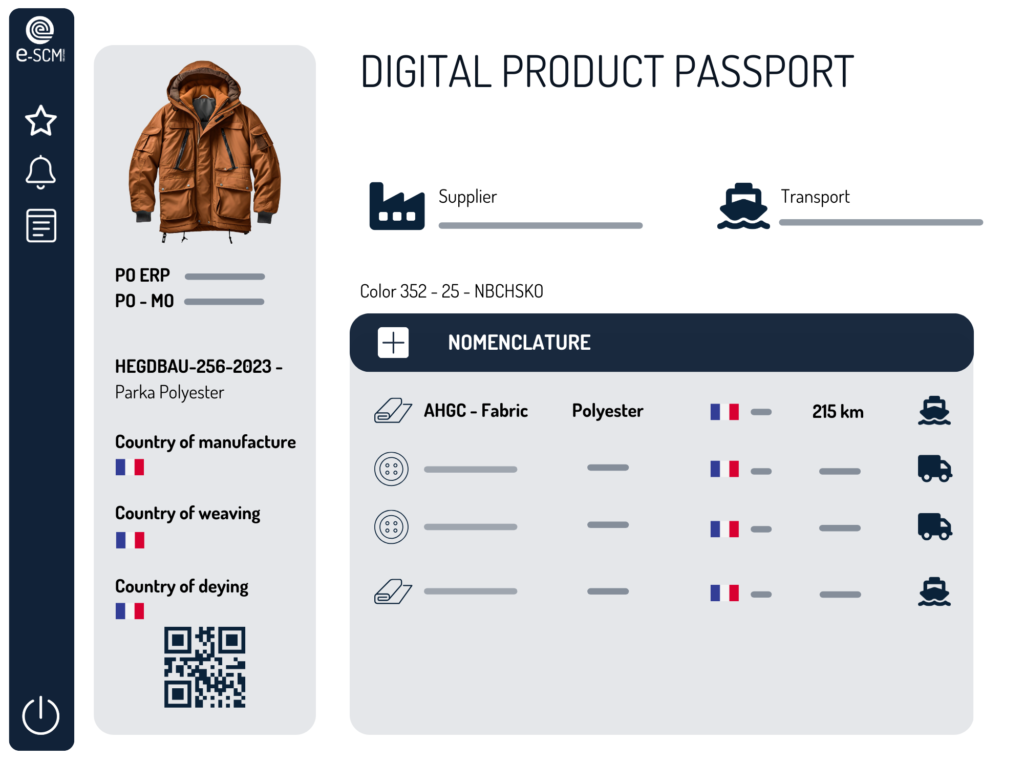
In the fashion and textile sector, PNP makes it possible to ensure the continuity of information and extend its scope to the entire product lifecycle.
By providing all stakeholders with access to relevant information, it enables consumers to make informed purchases and promotes the circularity of products and materials. This tool is all the more relevant as it helps to create links between the various actors in the product lifecycle who sometimes have divergent interests: supply chain companies, the different departments of the brands placing orders, distribution companies, consumers, authorities, assessment, certification and investment companies, media outlets, non-governmental organizations and circularity stakeholders.
The Digital Product Passport is a current and important topic, central to national and European strategies. In France, Article 13 of the AGEC law requires access to a product information sheet detailing the environmental qualities and characteristics of textile products at the time of purchase. This information includes the proportion of recycled material per product, microfiber emissions (if the product is primarily made of synthetic materials), traceability of the country of manufacture, and the potential presence of hazardous substances.
Environmental labeling (Climate and Resilience Law), expected to come into effect in the coming months, will complement the information available to consumers, enabling them to make informed purchases and participate in the sector's transition towards greater circularity. The Product Nameplate (PNP), as designed in this thesis, not only informs consumers but also extends product lifespans by storing key data for maintenance, repair, resale, and recycling. It could store information related to the Repair Bonus and track the various lifecycles of products to favor the most responsible companies that contribute to Extended Producer Responsibility (EPR).
The National Productivity Plan (NPP) occupies a central position within European regulations, aligned with the objective of a sustainable digital transition set out in the European Green Deal in 2019. The NPP is one of the key actions of the European Union's Circular Economy Action Plan (CEAP). It forms part of the Ecodesign for Sustainable Products Regulations (ESPR), the proposal for which was adopted in July 2023 and which will be finalized in 2024.
The textile sector is targeted as a priority with the 2022 European directive, the EU Strategy for Sustainable and Circular Textiles, and the EU CIRPASS project. The latter focuses on developing a roadmap to establish cross-sectoral system requirements and design prototypes for the priority sectors of textiles, batteries, and electronics.
We are now on our way to the Bali 3 program for the deployment of the Circular Product Passport which aims to extend traceability to all products, in order to generalize the collection and use of information about them.