e-SCM Traceability Module: Centralize your product data for a compliant and efficient supply chain

Why textile, fashion and luxury companies need to regain control of their product data

By 2026, brands face a proliferation of regulatory and environmental requirements.

Environmental labeling, Digital Product Passport (DPP), CSRD, customer requirements, supplier certifications: all these initiatives are based on the same strategic asset which is often underestimated.

Product data

However, in many organizations, the necessary information is still scattered between suppliers, ERP systems, Excel files, quality teams and CSR teams.

Result :

  • incomplete data;
  • multiple re-entries;
  • control difficulties;
  • lack of visibility;
  • Increased regulatory risk.


The e-SCM Traceability module was designed to meet this challenge by centralizing product and supplier data within a single upstream supply chain management platform.

Traceability is more than a documentary obligation

For a long time, traceability mainly consisted of storing documents and responding to audits.

Today, it is becoming a management tool.

Companies need to be able to know precisely:

  • the origin of the materials;
  • spinning countries;
  • countries of weaving or knitting;
  • the dyeing and printing stages;
  • garment manufacturing sites;
  • the associated certificates;
  • the environmental impacts of products.


This information becomes essential to meet regulatory obligations but also to secure sourcing and product development decisions.
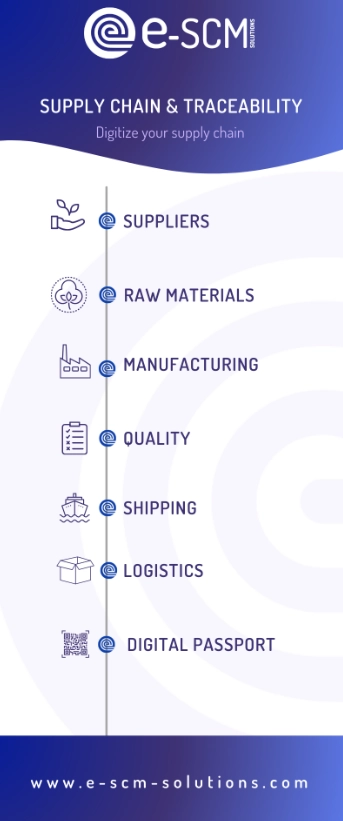
timeline of the traceability module e-scm solutions

A single platform to centralize traceability data

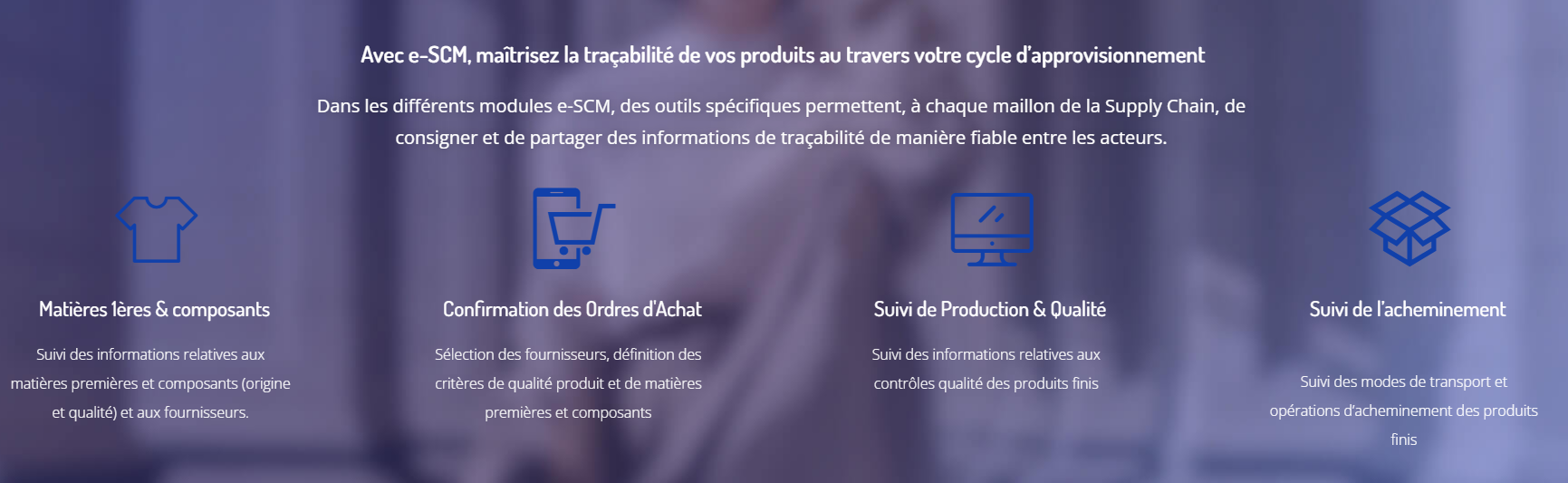
The e-SCM Traceability module allows you to structure all the information necessary for product management.

Teams can:

  • collect data directly from suppliers;
  • manage documents and certificates;
  • monitor the status of information completion;
  • secure the validations;
  • to store historical data.


The goal is to have a single, reliable and usable data source across the entire company.

This centralization avoids re-entry and limits the risk of desynchronization between different systems.
A concrete response to compliance challenges

The new regulations no longer simply require declarations.

They require verifiable data.


The Traceability module thus allows you to:

  • check the mandatory information;
  • track supplier certificates;
  • to ensure the reliability of product data;
  • prepare the information required for the Digital Product Passport;
  • to support CSR and ESG initiatives.


This approach allows Supply Chain, Quality and CSR teams to work from the same database.
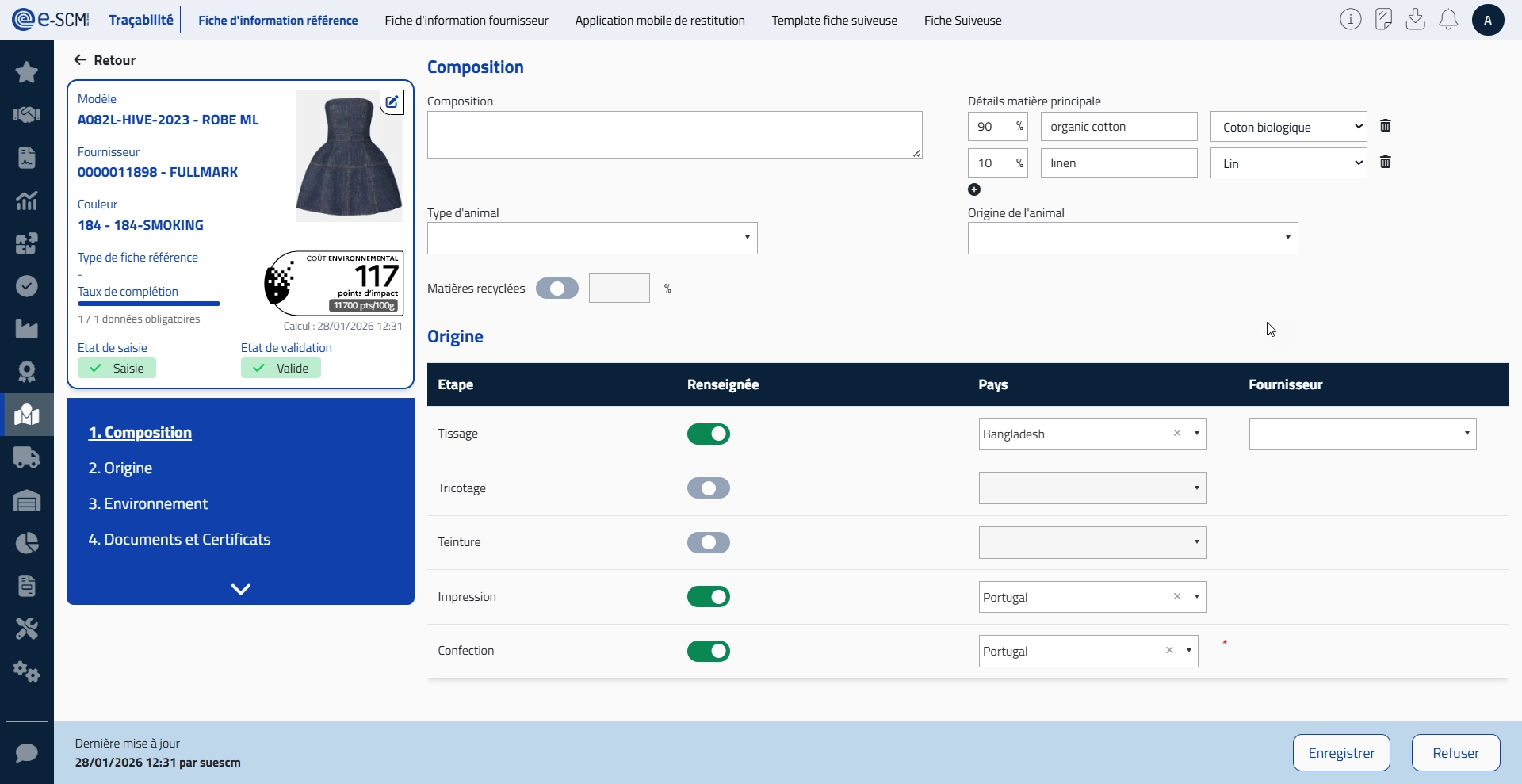
e-scm traceability module information sheet for solutions

Ecobalyse: transforming traceability data into an environmental score

One of the major innovations of the module is its native integration with Ecobalyse.

Rather than multiplying tools, e-SCM directly uses the data already present in the platform to automate the calculation of environmental cost.


Thanks to the connection to the official Ecobalyse API:
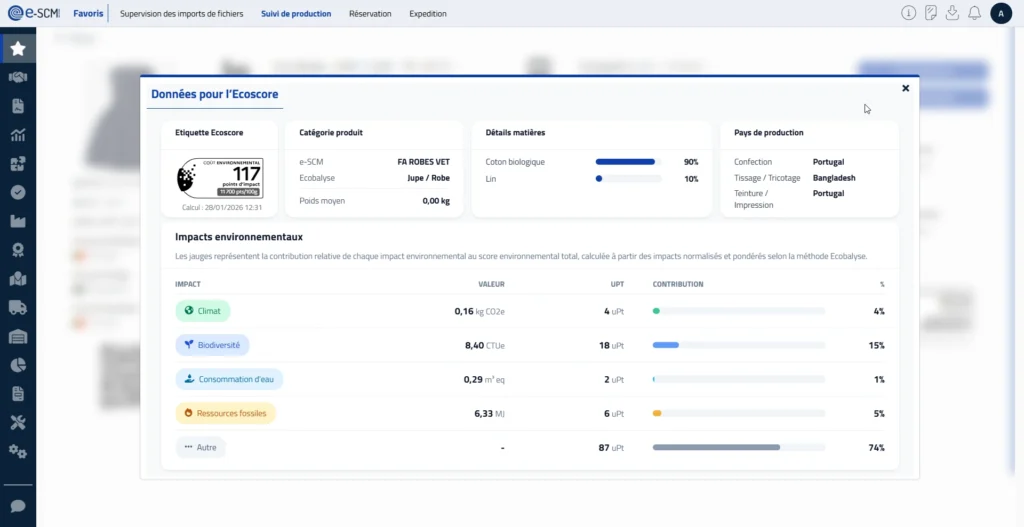
  • The environmental score is calculated automatically;
  • LCA impacts are recovered;
  • the repositories are kept up to date;
  • Incomplete records can be identified before calculation.
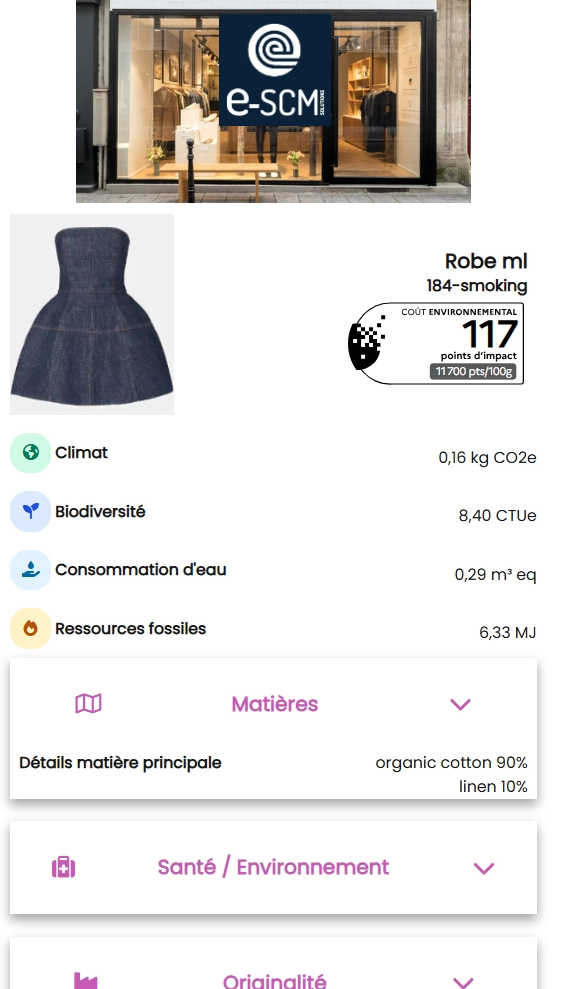
eco score module traceability e-scm

An automated calculation without double entry

One of the main obstacles encountered by the teams is the increase in manual treatments.


With e-SCM, environmental calculations are based directly on:

  • material data;
  • the weights produced;
  • countries of manufacture;
  • traceability information;
  • product reference data.


The score can be automatically recalculated during:

  • of the validation of a product sheet;
  • of updating a weight;
  • of a change in environmental data.
  • No manual export is necessary.

More than just a score: a true decision-making tool

The module's value is not limited to producing an environmental rating.


The teams also have a detailed view of the impacts:

  • Climate (kg CO₂ eq)
  • Biodiversity (CTUe)
  • Water consumption (m³ eq)
  • Fossil resources (MJ)


This restitution allows:

  • to compare several models;
  • to identify the levers of eco-design;
  • to evaluate different material scenarios;
  • to guide sourcing decisions.
QR code module traceability e-scm solutions

A rendering available on all media

Environmental information is directly accessible within the e-SCM ecosystem:

  • product sheet;
  • reference sheet;
  • Digital Product Passport;
  • mobile restitution;
  • QR Code;
  • export to Excel;
  • Environmental label compliant.


Field teams, CSR managers, product developers, and buyers all have access to the same data.

A direct benefit for Supply Chain management

The integration between Traceability and Eco-analysis addresses several strategic challenges identified by the Supply Chain departments of the textile and luxury sectors:

  • regulatory risk reduction;
  • improving the reliability of environmental data;
  • centralization of information;
  • consolidated multi-site vision;
  • alignment of Supply Chain, CSR and General Management.


Environmental data is ceasing to be an isolated subject and is becoming an indicator for managing the supply chain.

From compliance to competitive advantage

The most advanced brands no longer consider traceability as a mere regulatory issue.

They use it for:

  • strengthen their environmental credibility;
  • secure their product data;
  • accelerate their CSR initiatives;
  • to promote their material choices;
  • to prepare for future European regulations.


The e-SCM Traceability module makes it possible to build precisely this data foundation essential for sustainable performance.

Conclusion

Environmental calculation is just the tip of the iceberg.

The real value lies in the ability to collect, structure, control and leverage product and supplier data throughout the upstream supply chain.

By integrating Ecobalyse directly into the Traceability module, e-SCM offers textile, fashion and luxury companies a unique solution to centralize their data, automate their compliance and manage their environmental performance.

Because in 2026, the difference will no longer be based on the quantity of data available.

It is based on the ability to transform them into decisions.

FAQ

1. Why associate traceability with Ecobalyse?

Because the environmental score is directly based on traceability data: materials, weight, country of manufacture, and supplier information. Native integration avoids duplicate data entry and ensures more reliable calculations.

2. What data is used to calculate the environmental score?

The calculation is based on material composition, product weights, processing countries and data collected from suppliers.

3. What environmental indicators are available?

In addition to the overall score, e-SCM provides information on impacts related to climate, water consumption, biodiversity and fossil resources.

4. Where are the results visible?

The data is accessible directly in the product sheet, the Digital Product Passport (PPN), mobile feedback via QR Code and environmental labels.

5. What are the benefits for Supply Chain and CSR teams?

A single data point, automated calculations, less manual processing and better control of regulatory and environmental obligations.