Supply chains must evolve and become more resilientand agile to secure upstream flows and maximize service levels across different distribution channels: the right product, in the right place, at the right time.
Furthermore, consumer demand, amplified by the COVID-19 pandemic, demonstrates the need for transparent communication on production traceability

It is necessary to have a global and real-time visibility of the process in order to anticipate risks and to interact between all internal and external actors more quickly in order to minimize the impact of a hazard or non-conformity on the supply process .
The challenge is to adjust short-term forecasts, enhance quality control protocols, manage costs and delivery times more effectively, and ultimately improve the level of service.
Supply chain management tools optimize the management of the process, from order to delivery, offer the possibility of reacting in real time to unforeseen events and finding solutions quickly with the various stakeholders.
1. Stakeholder engagement
One of the key elements is thecommitment of management to support the project and to give credit to the desired transformation within the company.
Theinvolvement of all actors in the supply chain, whether internal or external to the organization, is essential to integrate all the data (quality/CSR, suppliers, freight forwarders, carriers, etc.)
Digitalizing the supply chain helps to secure the supply cycle and improve its efficiency by sharing global visibility throughout the process.

2. Rapid and controlled deployment
In order to maintain control over the deployment, the project initialization starts with standard settings and a connection to the company's information system.
Specific business workshops are held to adjust the settings and verify the data through successive iterations.
Support facilitates the adoption of the solution by business teams and accelerates change management among all stakeholders.
For a gradual ramp-up, the deployment is then generalized to all Product divisions and all stakeholders in the supply chain.
3. A reorganization of the supply chain process
To optimize the end-to-end supply chain, implementing a digital tool remains essential but not the only way! It is necessary to rethink the organization of the entire process for greater efficiency and to involve all stakeholders across departments: Quality, CSR, production, transport, for a global view of the supply process.
4. Towards more added value for supply functions
Supply teams still handle a lot of work manually, such as data consolidation, verification, and review. With the implementation of digital tools, employees acquire new skills and can focus on higher-value tasks.
The roles are evolving to focus more on decision-making, consultation, and stakeholder engagement. Jobs are becoming more specialized. Experience shows that on-the-job learning is a good way to involve teams.

Brands wishing to digitize their supply chain must begin by identifying the strategic priorities of the process and defining clear improvement objectives. They must then consider how to integrate all stakeholders across the chain to support them in this transformation.
Implementing a tool dedicated to optimizing and managing the Supply Chain is a clear success factor for structuring processes, standardizing actions and managing operations.
The e-SCM solution has now established itself as a benchmark for supply chain management. Our clients' feedback proves it!
e-SCM is a collaborative cloud solution that integrates all data onto a single platform in real time, enabling 360° supply chain transparency. It is designed for brands and integrates all stakeholders in the supply chain: internally (supply chain, purchasing, quality, CSR functions) and externally (suppliers, factories, carriers, etc.). It easily connects with your information system (ERP, PLM) and your data sources.
The right information at the right time
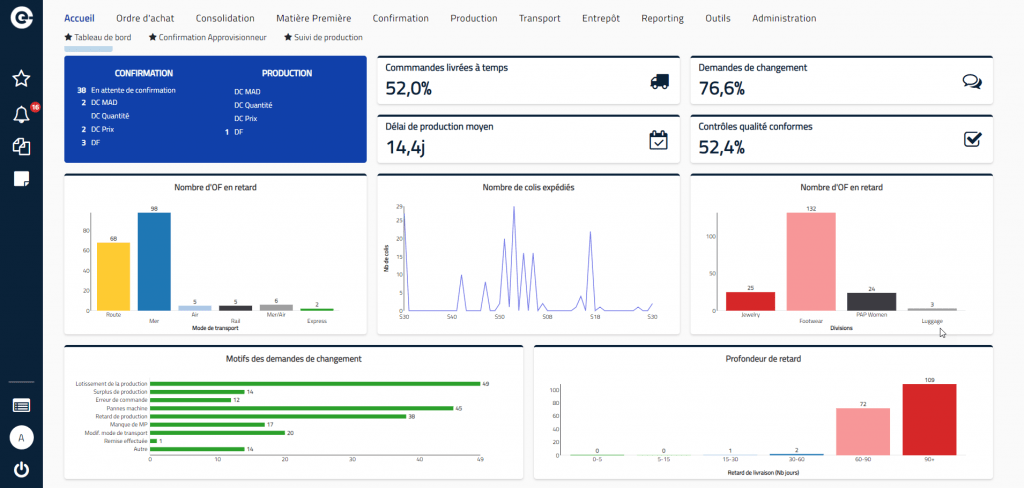
e-SCM helps you make the right decisions to anticipate risks and secure your processes. The monitoring dashboard provides a 360° view to manage your supplies in real time.
e-SCM's intuitive and user-friendly interface makes onboarding easy and allows you to be operational in less than 4 months. The benefits are visible from the first season: