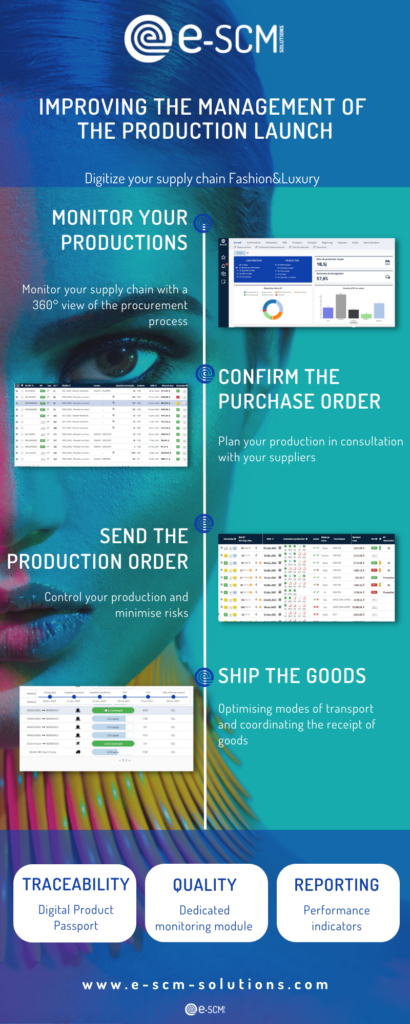
When discussing the upstream supply chain in the fashion, production represents the cornerstone of this stage for brands. Themain challenge is to produce stock compliant in the desired quantity. This challenge is all the more important as many brands diversify their sourcing and now offer several collections or capsule collections throughout the year.
In short, many expectations are placed on the stakeholders, namely buyers, sourcing agents and suppliers.
Production you is therefore the first step that our e-SCM to follow in detail and above all in real time.
Whether it is a finished product, a raw material or a component of which the brand is the buyer, the e-SCM allows the buyer and the supplier to agree on the conditions of each order, with the tier 1 partner suppliers.
To this end, the key elements of the order (quantity / price / delivery date / scheduling) can be reviewed and modified, if necessary, directly on the platform. The platform processes orders using a model/color/size matrix.
All exchanges are logged in real time. There is no need to wait for email confirmation from the supplier, as they are connected to the web platform and can respond quickly.
Once the commercial terms have been validated by everyone, production can be launched, sometimes with the addition of external components.
No need to panic, at this stage orders can still be modified and this will be synchronized in the ERP ! The main goal is to allow the buyer to minimize the risks associated with production uncertainties and to receive the most accurate stock possible. delivery to distribution channels timely.
The platform's key advantage is that it allows purchasing teams to define production indicators to track progress. Production indicators can include both production stages (cutting, assembly, fitting) and sample validation checks (fit sample, size set sample, preproduction sample). These latter elements are common practices in the textile industry.
To take this further, production milestones structure the order lifecycle. These milestones allow certain actions to be authorized or blocked, depending on their validity status. Therefore, production and/or shipping cannot begin until the production indicators on which the milestone depends are validated.
is generatedpacking list, and transport can be arranged. The platform allows suppliers to provide freight forwarders with visibility into the volume and quantities to be shipped, enabling them to anticipate transport capacity. The freight forwarder can then log in manually as a user or be automatically connected.
On the other hand, the platform allows, thanks to the recorded packing lists, for the automatic grouping of shipments by points of departure.
The logistics department then manages transport from the platform to the scheduling of deliveries to the warehouse, including appointment booking. This is the key strength of the e-SCM; its standard version integrates a TMS (Transport Management System) , which you will find explained in the article " E-SCM and the Transport Management System (TMS): total traceability".
Platform data is fed via APIs : both product listing data and purchase orders are directly sourced from your systems through interfaces based on APIs provided by e-SCM. We typically connect to ERPs the most common PLM , or WMS as needed (some examples include Cegid's Orli, SAP, AS400, M3, BC, Navision, Centric, Lectra, etc.).
The APIs provided secure exchanges, control the origin of the data and its reliability, optimize the operation and monitoring of applications while minimizing system desynchronization.
The solution is available as SaaS, on-premise or on our own cloud.
Connecting all partnersand across the entire supply chainin valuingthe partnership a. the transaction Beyond operational aspect , digitizing procurementwith each of them places suppliers at the heart of the relationship, rather than simply as participantswill allowthe brand achieverapid. to gains productivity and reduce the volume of supplier disputes
Are you ready to digitize your productions?