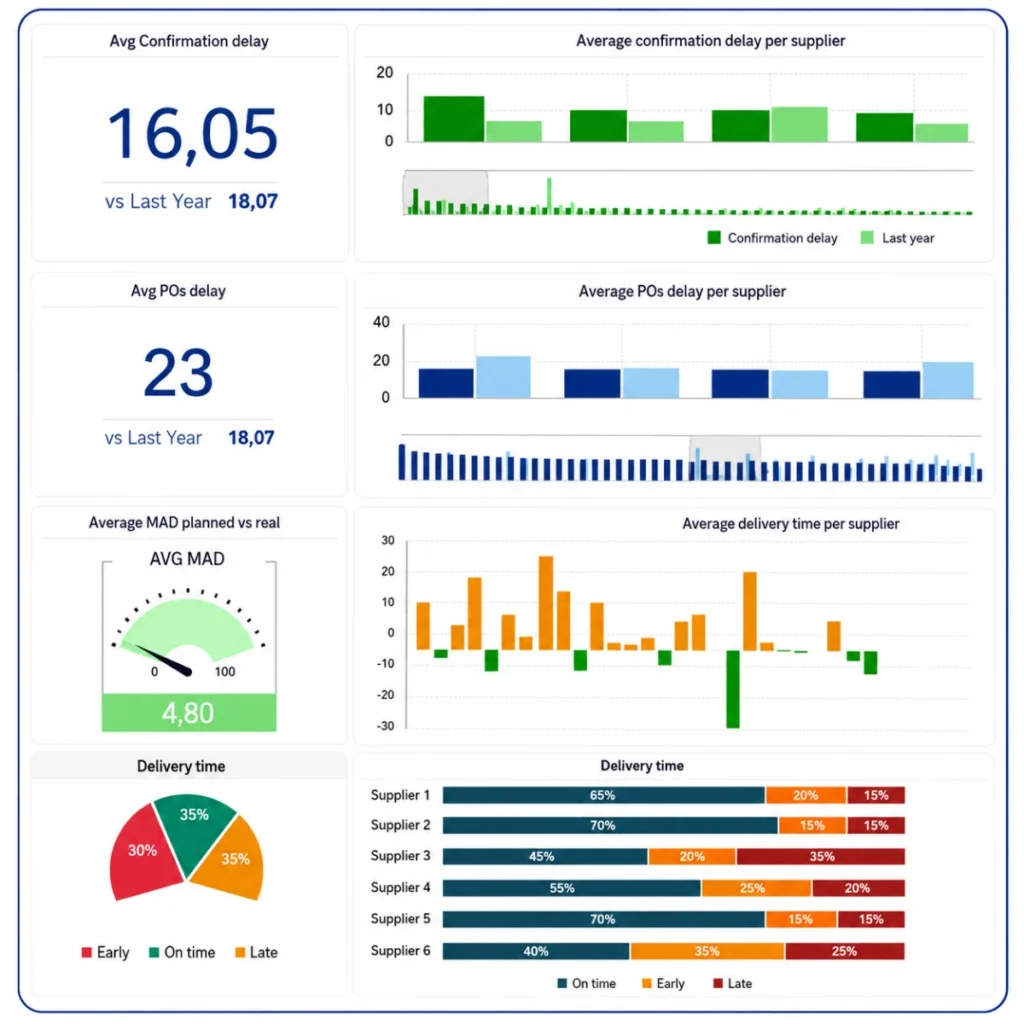
Companies generate increasing volumes of data daily from procurement, production, transportation, and quality control. Yet, according to Gartner, fewer than one in four organizations believe they are deriving significant benefits from their analytics supply chain. The challenge is therefore no longer simply accessing information, but rapidly transforming it into actionable decisions.
With module Insights e-SCM, the data already centralized within the platform becomes dashboards, KPIs, and analyses directly usable by the Procurement, Transportation, Quality, and CSR teams. This provides companies with a shared view of their performance, enabling them to manage their operations more effectively and implement a continuous improvement approach.
Summary :
Logistical crises, supply chain tensions and increasing traceability requirements have profoundly transformed business expectations.
According to a McKinsey study, major supply chain disruptions can lead to a loss equivalent to nearly 45% of annual operating profit over a ten-year period. In this context, the ability to quickly identify performance gaps and make the right decisions constitutes a major competitive advantage.
However, many organizations continue to manage their business using scattered Excel files or complex, difficult-to-maintain reports.
The Insights e-SCM module offers a different approach: directly leveraging the data already present in the platform to provide complete and shared operational visibility.
Every day, e-SCM centralizes essential information on:
With Insights, this data is automatically transformed into dynamic dashboards that allow you to:
The goal is simple: to allow teams to spend less time consolidating data and more time taking action.
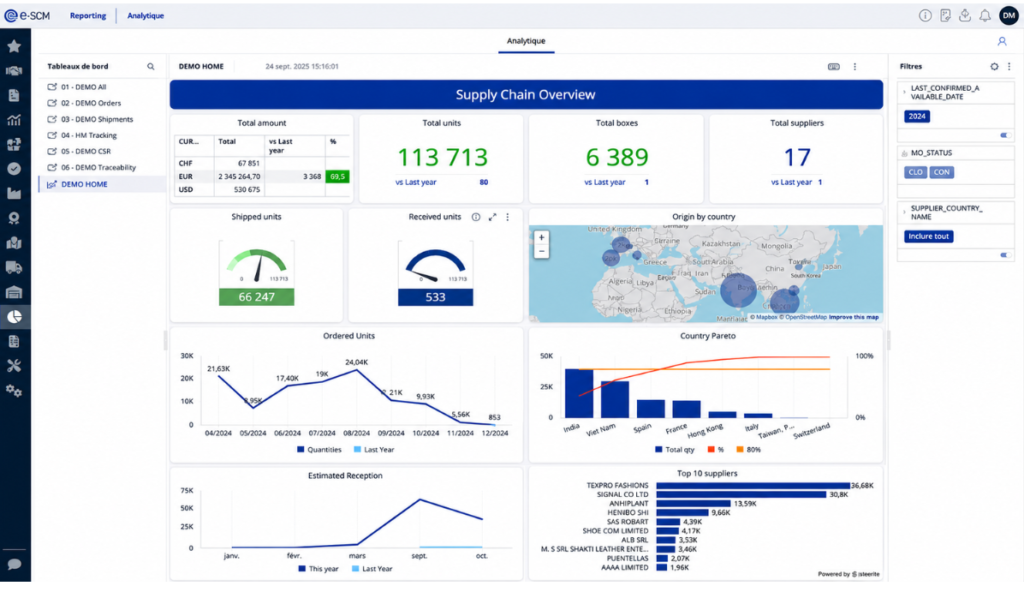
Example of a general reporting dashboard for the Insights e-SCM module
Supply disruptions still represent one of the main operational risks for manufacturers today.
In a context where companies are seeking to strengthen their resilience, visibility into supplier performance has become a strategic priority. Gartner shows that the highest-performing organizations are also those that most extensively leverage analytics integrated into their supply chain processes.
The Insights module allows you to track, among other things:
This allows teams to quickly identify the best performing suppliers, anticipate risks and implement targeted improvement plans.
Logistics costs remain highly susceptible to market fluctuations, while service quality depends on the ability to quickly detect performance gaps. Having consolidated indicators is becoming essential for managing costs, lead times, and service quality.
Transportation often represents one of the first variable cost items in the supply chain.
Insights dashboards allow you to track:
Thanks to a consolidated view of the data, logistics managers can detect deviations more quickly and optimize their operations.
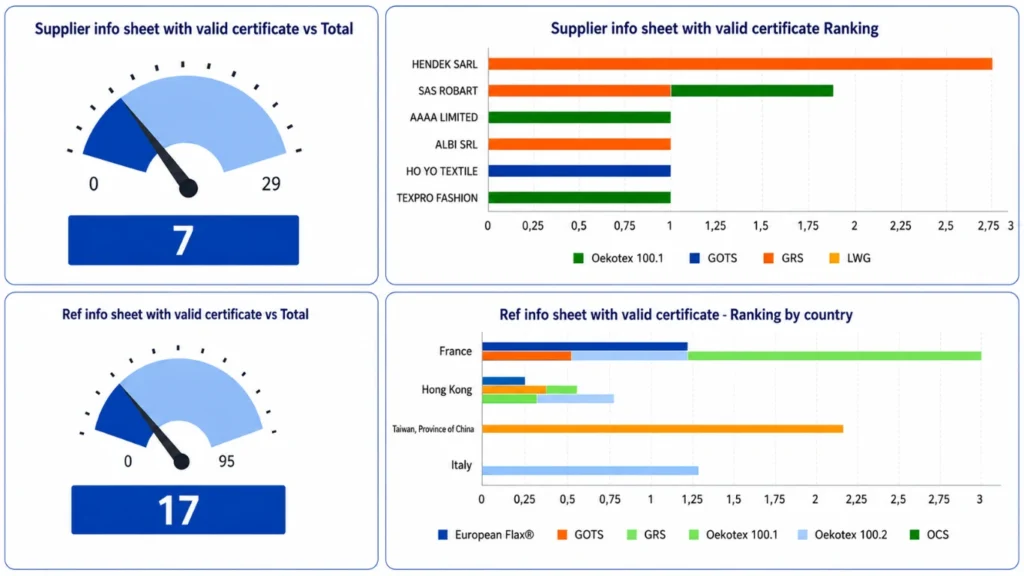
New European regulations (CSRD, due diligence, Digital Product Passport, Ecodesign Regulation, etc.) strengthen traceability requirements throughout the supply chain. Companies must now be able to document the origin of products, the materials used, and associated environmental indicators.
The Insights module makes tracking easier:
This visibility allows companies to better meet regulatory requirements while showcasing their CSR commitments.
One of the most frequent obstacles to decision-making projects remains their complexity of implementation.
Despite increasing investments in analytics solutions, Gartner reports that less than a quarter of organizations are currently achieving a high level of improvement through their supply chain analytics initiatives. Success depends less on the technology itself than on the ability to integrate analytics directly into the tools used by operational teams.
The Insights module adopts a decidedly operational approach:
Teams thus quickly gain actionable insights into their business without undertaking a complex BI project.
Supply chain performance relies primarily on the ability of the various stakeholders to work from common information.
By centralizing key indicators in a single environment, the Insights module enables:
The highest-performing companies are no longer distinguished solely by the quality of their data, but by their ability to rapidly transform that data into actionable decisions. By integrating reporting directly into the heart of business processes, the Insights e-SCM module enables a shift from descriptive reporting to true supply chain performance management.