In an economic environment marked by volatile supplies, a proliferation of partners and accelerating regulatory requirements, companies today must manage increasingly complex supply chains.
Whether in manufacturing, consumer goods, equipment, distribution or the textile sector, organizations face the same challenges: improving their operational visibility, effectively leveraging their data and strengthening collaboration with their partners.
To address these challenges, e-SCM Solutions , by MyTower , is evolving its collaborative platform with new features designed to simplify supply chain management, improve decision-making and support compliance and sustainability efforts
The performance of a supply chain depends as much on the quality of the data as on the ability of teams to use it quickly.
With the redesign of its screens, e-SCM, by MyTower, offers a more modern, smoother and more operational excellence-oriented user experience.
This development brings:
The supply, logistics, quality and production teams thus benefit from a more intuitive working environment, allowing them to process daily operations more quickly and reduce low value-added tasks.
This modernized ergonomics also contributes directly to:
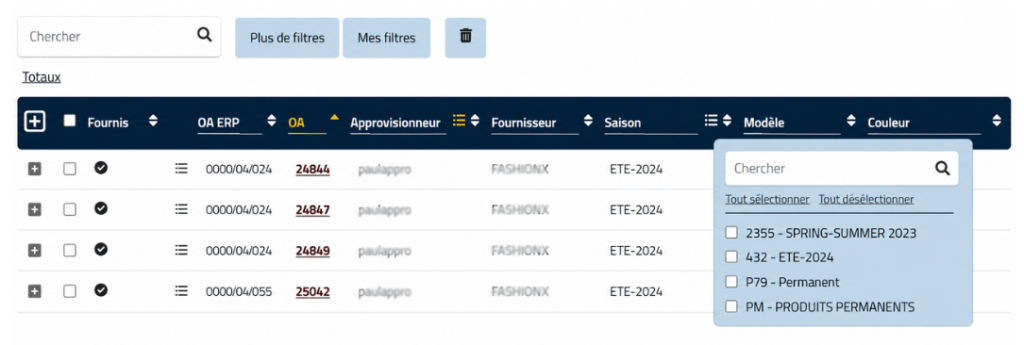
Example of a table with rich filtering functionality e-SCM
Companies today have a considerable amount of operational data. Yet, one of the main challenges remains its use to effectively manage business operations.
The new Insights e-SCM module , by MyTower , addresses this challenge by integrating advanced reporting and analysis capabilities directly within the platform, based on data collected throughout the chain.
Thanks to ready-to-use dashboards, users can:
The module also allows for cross-analysis, the use of advanced filters, and data exploration through drill-down functionalities to quickly identify the causes of performance gaps, for example.
For Supply Chain, Purchasing, Operations, and Quality departments, this consolidated visibility is a major driver of continuous improvement anddecision support. In a context where companies are seeking greater resilience and agility, the ability to transform data into action becomes a decisive competitive advantage.
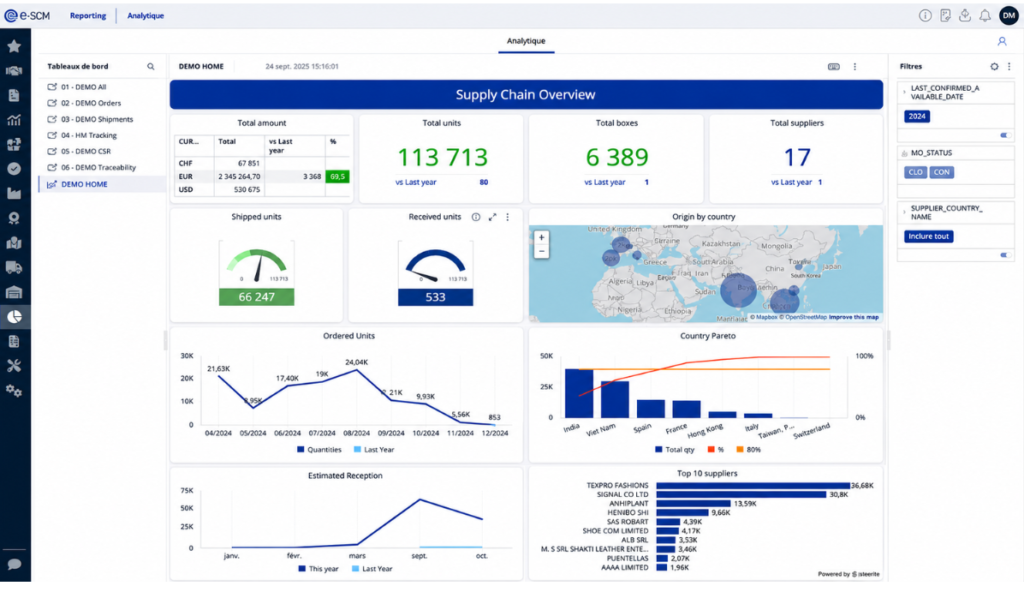
Example of a general reporting dashboard for the Insights e-SCM module
Product traceability has become a strategic issue for many companies, and particularly for players in the textile, fashion and luxury sectors facing evolving environmental regulations.
To support its clients in this transformation, e-SCM, by MyTower, is enhancing its Traceability module with an automated environmental cost calculation feature based on the Ecobalyse API. Directly integrated into the platform, this feature leverages existing traceability data to automatically calculate the environmental score of products without requiring re-entry.
Companies can therefore:
The environmental impacts, calculated using the Ecobalyse LCA, include in particular:
This approach allows CSR, Quality and Supply Chain teams to have direct access to centralized environmental data, and facilitates product compliance.
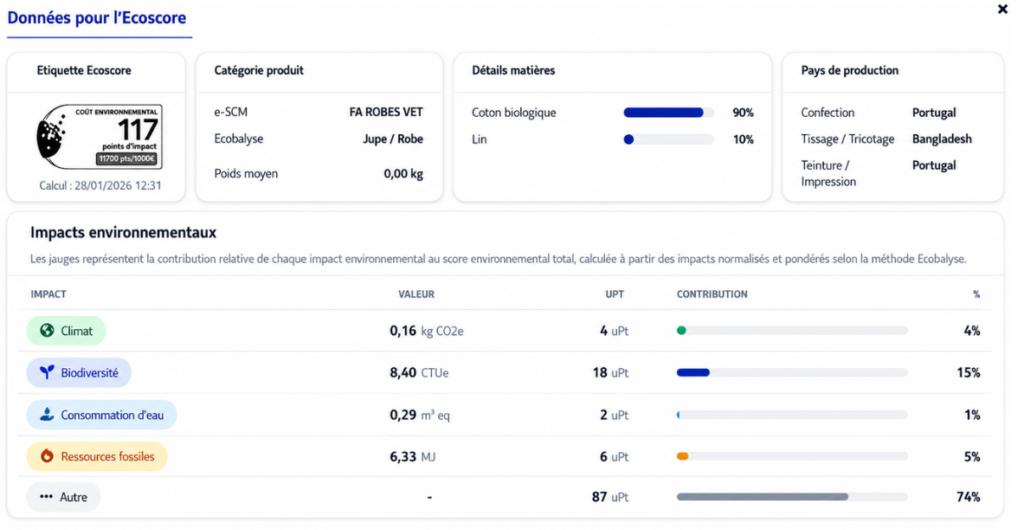
Data dashboard for the e-SCM environmental score
Beyond the features, the mission ofe-SCM, by MyTower, is to enable companies to better collaborate with their entire ecosystem: suppliers, subcontractors, logistics partners and internal teams.
By centralizing operational data within a single platform, organizations can:
Faced with ever-expanding and interconnected supply chains, data mastery is becoming a key factor in competitiveness.
With these new innovations, e-SCM Solutions confirms its positioning as a collaborative supply chain management platform, serving companies that want to gain visibility, performance and compliance.