
Securing and streamlining supply chains has become a critical issue for fashion and luxury brands. The COVID-19 pandemic severely disrupted global supply chains, revealing their fragility. Added to this are geopolitical tensions that exacerbate the instability of supply chains and the risk of disruptions.
In this context, brands must evolve their models to become more responsive while reducing risks. Suppliers are no longer simply executors but true partners integrated into the overall performance of the supply chain.
Securing flows and improving operational agility is now a central lever for competitiveness.
Article updated on 04/05/2026.
A major challenge for the Fashion & Luxury sector
Managing your supply chain while minimizing risks and disruptions has become complex. A single error can impact the entire chain in a domino effect.
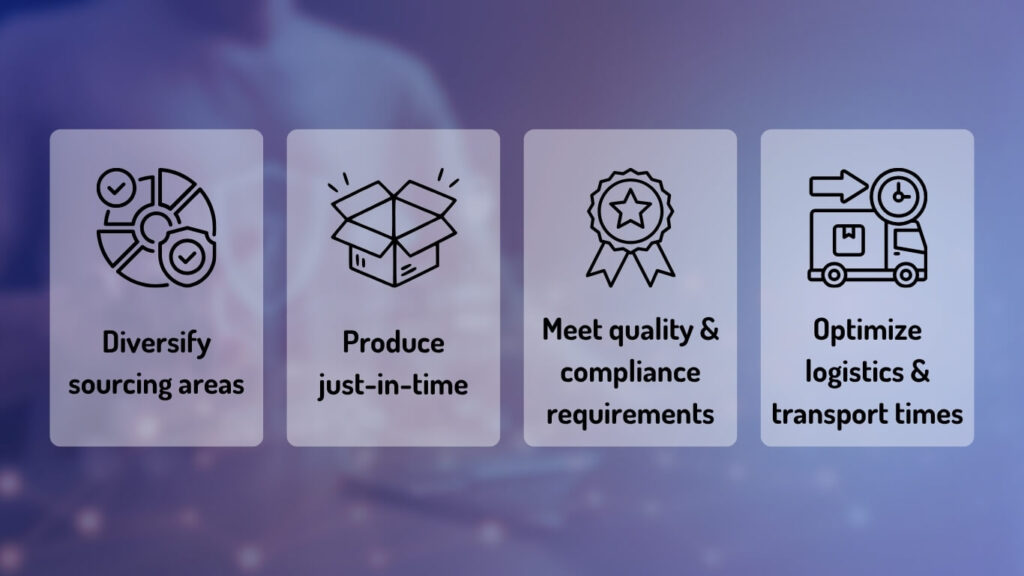
Diversifying sourcing locations reduces dependence on a single supplier or region. It is now a key lever for managing supply chain risks and is widely integrated into the purchasing strategies of companies in the sector.
Producing precisely and on time helps limit excesses, reduce the risk of errors, and improve overall control of the supply chain. This approach addresses both economic and environmental challenges.
Meeting quality and compliance requirements helps to secure the entire production process and reduce risks at every stage of the chain.
Optimizing logistics and transport times remains a key lever to limit the risks of delays and secure flows.
Making your supply chain more agile means improving overall visibility, tracking data in real time, and making the right decisions at the right time.
Visibility across the entire supply chain allows for anticipating risks and improving operational responsiveness. It is essential for optimizing service levels.
Promoting exchanges between brands, suppliers and subcontractors helps to streamline processes and reduce operational friction.
e-SCM Solutions operates on:
e-SCM Solutions helps procurement professionals through:
e-SCM Solutions improves visibility through:
The current context, marked by geopolitical tensions, has highlighted the need to strengthen the resilience of organizations.
Digital transformation makes it possible to collect data wherever it is located, to obtain it in real time, to automate processes and to increase overall visibility.
Digitalization is a key driver for optimizing the upstream supply chain in the fashion and luxury sectors. It enables data centralization, process automation, and improved traceability of flows. In this context, digitalization for supply chain security is essential for resilience and performance.
Securing and streamlining the supply chain is now a central challenge for fashion and luxury brands. In an unstable environment, performance depends on the ability to combine secure flows, operational agility, and digital transformation.
