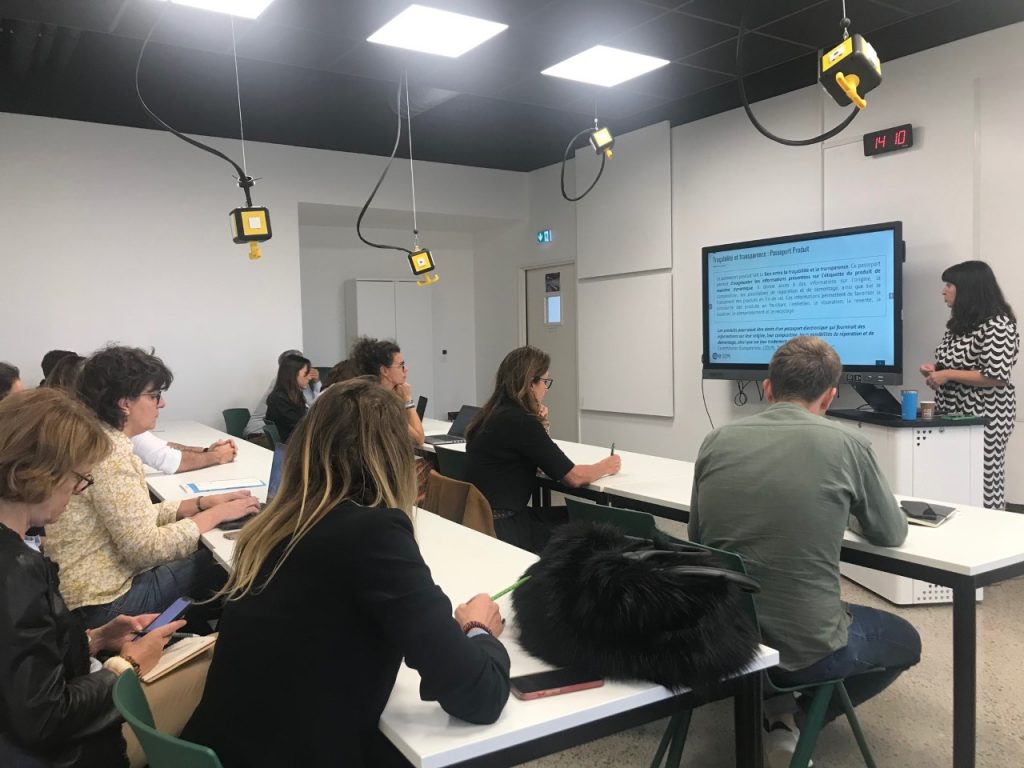
On October 20th, as part of " Biarritz Good Fashion ", organised by the Bali Chair in partnership with Paris Good Fashion, Belharra led a participatory workshop on the following theme: "Let's imagine a circular product passport."
In collaboration with Dimitri Masson, PhD in Computer Science, teacher and research engineer at ESTIA, Pantxika Ospital, a doctoral student at Belharra on the theme of " Traceability & Transparency ", presented the work carried out over the past year:
The workshop brought together around fifteen representatives from brands, consulting firms and professionals, which opened up discussions and the sharing of viewpoints around 3 fundamental questions, the summary of which we present below.
To kick off the discussions, Pantxika Ospital recalled the definition of the main concepts and repositioned the issues of the Digital Product Passport.
The Digital Product Passport bridges the gap between traceability and transparency . This passport dynamically enhances the information displayed on the product label . It provides access to information on the origin, composition, repair and disassembly options, as well as end-of-life product management. This information promotes product circularity by facilitating maintenance, repair, resale, rental, dismantling, and recycling.

A major theme of the BALI Chair, traceability is central to the challenges of sustainable fashion. In partnership with PARIS GOOD FASHION and under the direction of BELHARRA Numérique, the Chair presents a state-of-the-art overview of traceability and transparency solutions. Find out more:
This document is based on the ongoing work of Pantxika Ospital and co-written with Bixente Demarcq, research engineer.
After a presentation of the Digital Product Passport promoting circularity, we collectively reflected on 3 questions that structured the discussions:
By centralizing product data, brands can better manage their production chain and track their products after they are sold. Using product data management (PDM) helps build customer loyalty by encouraging participation in a circular economy, extending the lifespan of products through repair, rental, resale, and more efficient recycling.
The information collected makes it possible to consolidate a database usable by different user profiles at different levels: at the headquarters of the brands, in stores and after-sales for consumers and third parties (regulatory, trusted).
Depending on the users and the stage of the product's lifecycle, the information to be collected may concern the companies involved in the supply chain, product descriptions, the origin of materials, and the various impacts: social, environmental, and health-related. Sharing a common standard for the collected data would improve clarity for consumers and allow for product comparability using industry-standard indicators (durability, eco-design, recyclability). This enhanced label, accessible through a durable technological means, is nevertheless limited by the lifespan of the labels and chips (QR code, NFC, RFID).

This Digital Product Passport, designed to promote circularity, will require consumer participation so they can enter information about the product's lifecycle after the sale. In compliance with the General Data Protection Regulation (GDPR), it is essential to engage customers by creating a fun and educational user experience that strengthens the bond between consumers and the brand. Organizing events, co-creation workshops, and incentives will create opportunities for new interactions.
TheCircular Product is the culmination of the Digital Product Passport, as it will allow brands to create a direct relationship with the consumers and users of their own products. This will make it possible to create a user experience that enhances the brand image and strengthens consumer loyalty to the product.
The Circular Product Passport will become essential for developing new economic models around a second-hand market, product rental or for recalling products in order to valorize materials through recycling, reuse or repurposing.
It is clear that the systematic generation of a Digital Product Passport for each product is a strategic issue and that control of traceability data is becoming central.
This is the whole point of the e-SCM and the innovation approach that has been in place for several years.