Made mandatory within the European Union from 2027, what challenges do companies face in implementing a Digital Product Passport that complies with regulatory requirements and supports the transition to a more responsible and economically efficient fashion industry?
We met up with our 2 e-SCM Solutions alongside members of the BALI Chair – Biarritz Active Lifestyle Industry for the round table: The digital passport of products: regulatory issues and implementation challenges.
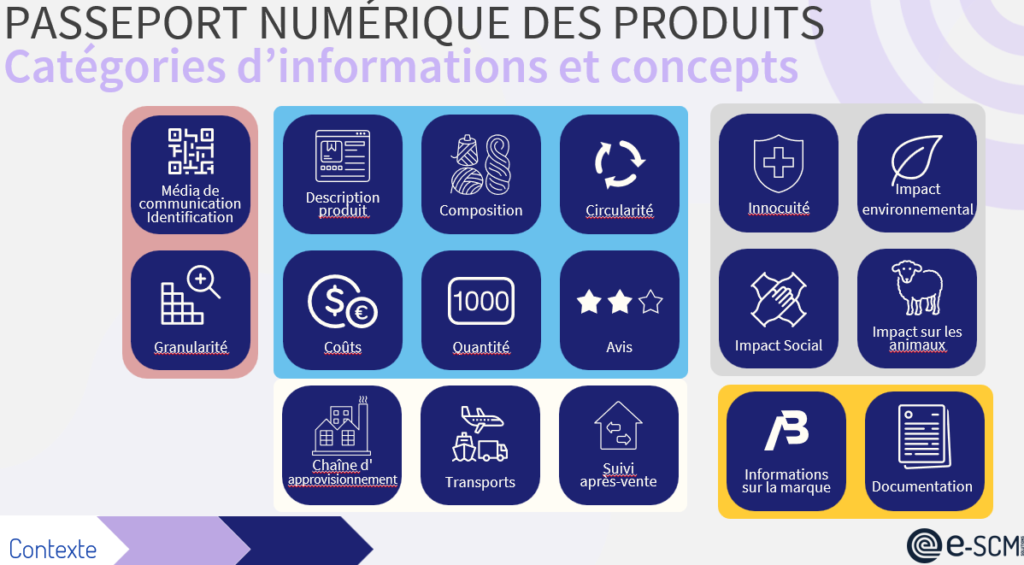
Pantxika Ospital, a PNP-PhD consultant specializing in e-SCM, spoke to explain the benefits of the Digital Product Passport, particularly in the textile and fashion sector. Traceability in supply chains is essential for monitoring the product lifecycle and allows brands to move towards agile and sustainable production.
Patrick BOURG, Director of Operations, e-SCM, had the opportunity to moderate this round table!
Maurine Poirier, Environmental Labeling Engineer atDEME:
“The digital product passport is something consumers truly expect. Displaying this score allows us to connect with customers and demonstrate greater transparency. It’s a genuine eco-design tool that combats greenwashing, in line with the fast fashion law. It’s crucial for companies to adopt this tool to better design their products and anticipate future regulations in 2025.”
Yohann Petiot, Managing Director, Alliance du Commerce
: “The digital product passport is a must: it’s a lever for change for businesses and a foundation for transformation. There’s an economic benefit for companies. Today, the challenge is to get suppliers on board, as they have their own constraints. At a collective level, we need to consider standardizing this data. Traceability is a tool and should be a means of transformation: but the key is to take action to transform.”
Audrey C., Development Manager, OXBOW:
“What we’ve seen in recent years with the various laws is that the supply chain is very aware that it may be asked to provide data. It’s prepared and monitoring regulatory changes. The most complex aspect is knowing how to organize this data collection so that it’s not too burdensome for all the players in the sector. Collective buy-in is essential. We certainly need to evolve, but we must do so with finesse. Data analysis is a source of learning: it provides opportunities and perspective on what can be improved.”
Pantxika Ospital, PNP Specialist Consultant – PhD, e-SCM Solutions:
“PNP is a tool to enable new uses and meet the challenges of the textile and fashion industry. Traceability is crucial in supply chains, which bring together companies of different types and sizes, often geographically distant. In the fashion and textile sector, it ensures the reliability of information continuity and extends its scope to the entire product lifecycle. It is an asset for companies to better manage their supply: towards more agile production.”
Pantxika Ospital, who earned her doctorate a year ago and has four years of experience as a specialist consultant at e-SCM, remains at the heart of the traceability and transparency research group within the BALI Chair. The e-SCM offers a supplier portal that allows fashion and luxury brands to optimize and coordinate their supply chains and supplier relationships. This innovative digital framework aims to meet the growing demands for traceability while strengthening transparency within the industry.
Regulatory evolution is a major challenge for businesses today. This "tsunami" of new compliance requirements is forcing brands to fundamentally rethink their practices. Several key regulations are driving this transformation, each imposing specific obligations designed to govern industry practices.
These regulations not only concern the companies themselves, but also the specific products they manufacture, requiring more rigorous monitoring and control of manufacturing processes.
French legislative reforms complement this dynamic of increased compliance:
The European Green Deal provides the framework for this transformation towards more sustainable and circular production. By integrating digitalization into industrial processes, this plan aims to make Europe a global model for eco-responsible production. The transition relies heavily on data collection, which is essential for measuring and optimizing the environmental impact of products throughout their entire life cycle.
To ensure complete transparency, it is now crucial for companies to collect data continuously, step by step, rather than on an ad hoc basis. Integrating data collection into each stage of the process not only mitigates impacts but also increases the reliability of the information gathered. The transition to sustainable production therefore requires a structured approach, where each step is documented in real time to facilitate the management of environmental performance.
The implementation of this regulatory framework is redefining the contours of responsibility and transparency in the fashion and luxury industry. In this context, digital solutions such as the e-SCM portal enable brands to meet the requirements of traceability, transparency, and sustainability, while adapting to constantly evolving European standards.