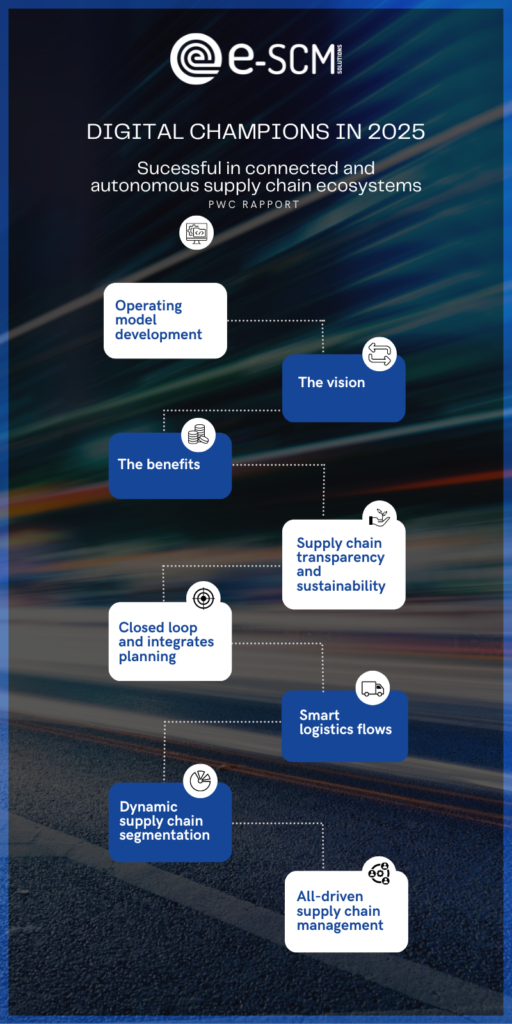
According to the report " Connected & Autonomous Supply Chains 2025 ,"PwC its shares vision of supply chain evolution by 2025, based on a survey of executives worldwide. The on report focuses thecountries Nordic: - onlyend supply chain planning, while 72% of the " championsdigital - " have already done so.
So, where are we halfway through 2023?
Do you consider your company to be a "digital innovator" or a "digital champion"?
Most B2B supply chains have been affected by the aftermath of the pandemic. A fourth industrial revolution is underway, with technology in all aspects of the business.
Retailers and fashion brands want to be even more customer-centric, but to meet customer expectations, they must address challenges in managing their suppliers, such as contingency plans, quality compliance, and logistical disruptions. Suppliers are becoming partners rather than just intermediaries.
program transformation has become essential in a volatile environment. Linear supply chain models no longer apply to market demands, and companies are looking for autonomous and connected ecosystems where all supply chain partners meet and contribute in real time.

All relevant internal functions will be connected via a common data network , from R&D and manufacturing to procurement, logistics, marketing, and sales. Data is therefore continuously available throughout the supply chain. The study shows that most companies have adopted this approach and invested in new supply chain technologies and organizational models, with the " digital champions " far ahead. They have invested in advanced supply chain technologies and will continue to do so.
Technology . is essential to making this transformation possible: it enables dynamic monitoring of operations, from order receipt to raw material procurement, through production, delivery and even reverse flows, where companies become responsible for the recovery of end-of-life products
The benefits are visible in the short term, with increased profitability and better asset utilization, and digital champions clearly see the advantages of supply chain optimization for improvements across their entire business. Key success factors for such a project include engagement in process evolution and change management, solution selection , and scalability.
solution e-SCM, dedicated to supply chain management for the fashion and apparel industry, provides a single platform to connect your partner ecosystem and cover the entire process: order confirmation, production tracking, shipment management, and delivery. It can be synchronized with ERP software and automatically connected to freight forwarders viaAPIs.
Our clients such as Hummel, Rip Curl, Eden Park, have adopted our e-SCM solution, enabling the integration of all partners and the tracking of supply up to warehouse delivery.